Relaxation exercises to combat stress: 8 proven methods
Which techniques, from breathing exercises to meditation and yoga, can help you combat stress and relax quickly? Find out how you can use tried-and-tested relaxation methods to reduce stress in your daily life in a targeted and lasting way.
Why relaxation is important to combat stress
Everyone needs periods of calm and relaxation. If you are permanently tense, you are also less able to perform. You feel unwell and your health suffers. The reason: when under stress, the body releases stress hormones such as adrenaline and cortisol. If you don’t relax afterwards, your body won’t break down these hormones. If this is happening all the time, specialists refer to it as chronic stress.
Possible consequences of chronic stress:
- High blood pressure
- Digestive problems
- Tension
- Chronic headaches
- Sleep disorders
- Burnout
- Depression
- Anxiety disorder
What effect does relaxation have on the body?
People who internalise the relaxation exercises are better at coping with stress. The exercises are particularly effective if you regularly integrate them into your day-to-day life and make them a ritual. If you feel that a situation is causing stress or could cause stress, the relaxation methods can also help to prevent things from escalating – they make you more relaxed, mindful and resilient.
If you consciously relax, you will feel calm inside. You’ll also find it easier to concentrate and benefit from the positive effects on your body. Take deep breaths, in and out. Your body settles down and you slip into a relaxed state. This reduces muscle tension and slows your pulse and breathing. The body produces happiness hormones, These, in turn, help with stress management.
The number of breaks you need per day depends on your job. For example, whether you work in an office or do physical labour. A good rule of thumb: take a short break as soon as your concentration starts slipping or your performance level drops. Avoid prolonged stress and relieve pressure early on. More important than the relaxation method you choose is that you switch off regularly. Just a few minutes a day can help to relieve stress at an early stage.
Which relaxation method is the right one?
There is no right or wrong choice of method: it depends entirely on your preferences. When do you feel good? In peace and quiet? Or when you are active? It can also be inspiring to try the exact opposite. New experiences stimulate other senses and regions in your body. In short, try out one or more of the different relaxation techniques. You’ll quickly find out if the method works for you.
Our health consultation service will be happy to provide you with information about tried-and-tested relaxation methods and tell you more about our health apps.
Eight exercises to combat stress
There are many ways to relax. The following 8 have proved to be effective. Whether you’re interested in stress prevention or stress management – get to know the individual relaxation methods and find your favourites.
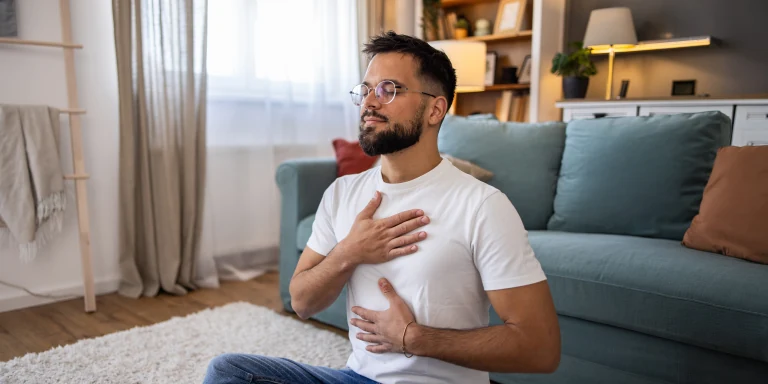
1. Breathing exercises for relaxation in every situation
If you are stressed, your breathing is restricted. This can lead to headaches, increased fatigue and tension. Breathing techniques can counteract these problems easily and effectively. They also help you relax. The basic idea: breathing is an automatic process, but it is influenced by your thoughts and feelings. Breathing exercises help you become more mindful of your breathing. This improves your overall respiratory function and thus your oxygen supply. It also reduces body tension.
If you need to relax quickly, try these breathing exercises:
- 4–7–8 breathing: breathe in for 4 seconds. Hold your breath for 7 seconds. Breathe out for 8 seconds. Repeat this 4 times.
- Five-finger breathing: hold out your hand with your fingers spread apart. Use the index finger of your other hand to trace around your fingers. Breathe in slowly as your finger traces upwards, exhale gently as you trace down. Hold your breath briefly at the tip of each finger. Repeat until you’ve traced around all five fingers.
2. Autogenes Training: Kraft der Gedanken
“My arms and legs feel very heavy.” This is how one of the most popular relaxation techniques begins: autogenic training. While sitting or lying down, you consciously relax through the power of your mind. This can be done anywhere and at any time without any props. Here’s how to easily incorporate this relaxation technique into your daily life, whether at home, on the tram, on the train or at work.
3. Progressive muscle relaxation: letting go through tension exercises
The principle of progressive muscle relaxation (or PMR), as developed by Edmund Jacobson, is easy. Certain muscle groups are deliberately tensed for a short time, one after the other, and then released quickly. After tensing the muscles, and with each PMR exercise, you relax more deeply and consciously.
4. Meditation: getting rid of inner restlessness
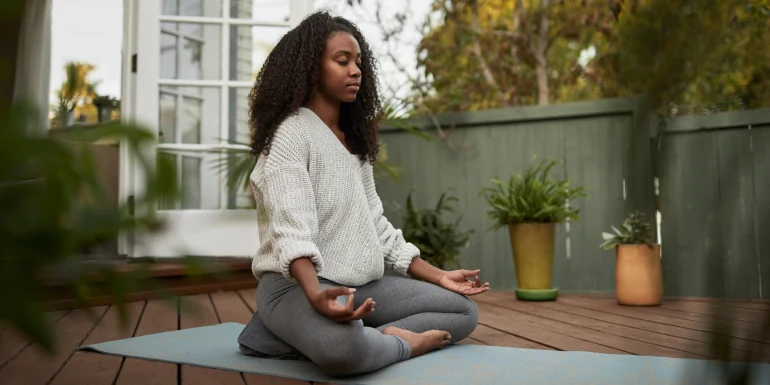
Meditation is a method dating back thousands of years and is based on mindfulness and concentration exercises. There are different meditation techniques. They include both physically active forms like walking meditation, as well as physically passive forms such as meditating while lying down, and transcendental meditation, in which a mantra is repeated internally while sitting in a calm pose.
5. Yoga: train your body and mind
Yoga is one of the methods for physical relaxation. It combines “asanas” (postures), stretches and breathing exercises. Controlled breathing makes you more mindful and creates inner peace. At the same time, you relax muscles, ligaments and connective tissue when you stretch. .
6. Mindfulness-based stress reduction: relaxation programme (MBSR)
“MBSR” doesn’t refer to one single exercise. Rather, it is an 8-week programme that teaches you how to reduce stress through mindfulness. Several components are key, including meditation, yoga and the body scan. An MBSR course takes place in groups and also includes everyday exercises, which you then incorporate into your daily life.
7. Feldenkrais exercises: release blockages
How do you turn on your side in bed? The Feldenkrais Method is dedicated to such everyday movements. This has a beneficial effect on your physical, emotional and mental well-being. It was invented by Israeli physicist and psychologist Moshé Feldenkrais (1904–1984). The basic idea: the way you think, feel, perceive and move are all interrelated. You become consciously aware of your body and its movements. This allows you to discover and change unhealthy movement patterns.
8. Alexander Technique: breaking unhelpful patterns
The Alexander Method also helps you relax. It was developed by Australian actor Frederic Matthias Alexander. He observed in himself that posture, movement and thought patterns are interlinked. By learning the Alexander Technique, you become more aware of yourself, recognise patterns and learn to influence them. For example, many people tense their neck when they get up from a chair. With the Alexander Technique, you practice moving consciously and freely.
Relaxation courses – covered by Helsana
COMPLETA supplementary insurance covers 75% of the costs of recognised health promotion courses, up to a maximum of CHF 200 per year. Find out what benefits are included.
How to find your relaxation routine
At this point, you are familiar with the different methods. Now it all comes down to how you integrate relaxation into your daily life. With a set routine, you will relax regularly. These tips will help you do that:
- Start the day feeling relaxed: you set the tone for relaxation in your daily life first thing in the morning. Put your smartphone aside for a while. Stretch and drink a glass of water. Gentle yoga exercises are also a good way to get your day off to a relaxed start.
- Try out a course: attend a course. This will teach you your preferred relaxation technique to combat stress (e.g. autogenic training) right from the beginning.
- Assess your needs: think about what you’re missing in your day-to-day life. Choose a routine that realistically fits into your day.
- Don’t set the bar too high: most importantly, select a simple relaxation exercise to start with. This will keep you motivated. Progressive muscle relaxation is very suitable for beginners.
- If in doubt, consult a specialist: if you are unsure which stress reduction exercise is right for you, talk to a specialist. This is particularly true for people with mental illnesses such as anxiety disorders or acute psychosis.
- Schedule time: note your exercise times in your calendar. That way, your daily relaxation won’t get sidelined.
- Stay open-minded and patient: Try new things. Don’t give up immediately if an exercise doesn’t work at first.
- Creating the right conditions: a balanced diet and enough exercise in your daily life are a good basis if you want to relax every day.
- End the day on a relaxed note: evening relaxation routines teach the body that it’s the end of the day. A short breathing exercise or PMR session before bed calms you down.
Why relaxation doesn’t always succeed: how to avoid typical stumbling blocks
We all find it hard to get started. Anyone who is new to relaxation exercises needs a bit of patience. Beginners often struggle with their own perfectionism: they expect the perfect exercise in the perfect environment right from the start. This expectation creates new pressure, which can actually intensify the symptoms of stress – in other words, exactly the opposite of relaxation. Lack of concentration also holds many people back. This is normal: the important thing is to carry on regardless – in fact, precisely for that reason.
If you only do relaxation exercises sporadically, you’ll hardly notice any progress. You will only see the effects if you keep practising. Similarly, many people only turn to the different relaxation techniques once the stress has already set in. Instead of that, do exercises in periods of calm. That way, the techniques will work when you really need them. Alternatively, they can reduce stress at an early stage, before it becomes chronic.
Just like cycling or learning a new language, relaxation can also be learnt. Each exercise takes you one step further. Choose a relaxation technique that you enjoy – and you’ll already have overcome the first hurdle.

The specialist provided the editorial team with advice and input for this article. Monika Fäh Rüegg is a nurse specialising in psychiatry and a systemic mental trainer, and has completed training in Viktor Frankl’s meaning-centred counselling. She works in Case Management at Helsana.
Newsletter
Find out more about current health issues every month and get all the information you need about our attractive offers from all Helsana Group companies * delivered by e-mail to read whenever it suits you. Our newsletter is free of charge and you can sign up here:
We did not receive your information. Please try again later.
* The Helsana Group comprises Helsana Insurance Company Ltd, Helsana Supplementary Insurances Ltd and Helsana Accidents Ltd.