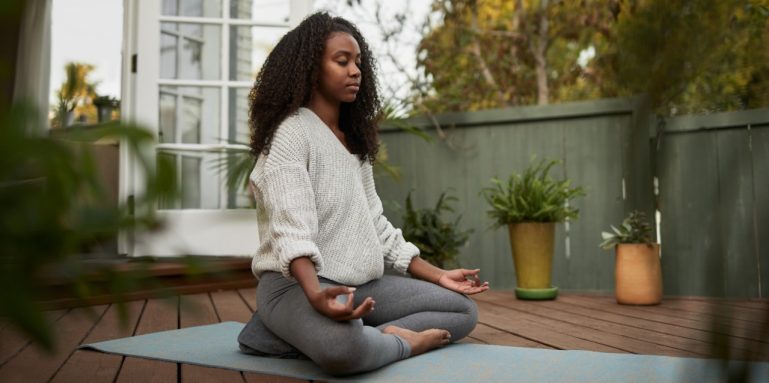
Meditation made easy
How can you meditate correctly? When’s the best time of day to meditate? Find out why just a few minutes of meditation every day supports your health and what other benefits it offers. With everyday tips for beginners.
What is meditation?
Meditation is a mental practice that aims to hone your awareness, attention and mindfulness. The word comes from the Latin (“meditatio”) and means “to reflect”.
In essence, meditation is about consciously perceiving the present moment without evaluating it. It’s a way to foster inner peace, clarity and deep relaxation from head to toe. Meditation functions like exercise for your mind: stress and anxiety are reduced and any negative thoughts float away. Meditation has long been a component of many scientifically recognised methods like yoga, mindfulness interoception® and mindfulness techniques such as MBSR (mindfulness-based stress reduction) – it doesn’t need to have any connection to spirituality.
There are many meditation techniques out there, from breathing meditation to body scans, mantra meditation and zen meditation. But they all have one thing in common: with each technique, you consciously focus on the breath, the body or the visualisation of a certain object, for example a light.
Benefits of meditation for body and brain
Experts have been researching the effects of meditation for decades. The results are clear: regular meditation strengthens the body and the mind. Just a few minutes a day can help many people reduce stress and sleep better.
After just 6 to 8 weeks, regular meditation has a biologically measurable impact on the brain, immune system and cardiovascular system.
- Meditation is an effective way to prevent stress and contributes to active stress management. Many complaints improve as a result: mindfulness has a clear impact when it comes to alleviating sleep disorders, pain, anxiety and depression.
- The immune system is strengthened: regular meditation reduces the levels of inflammatory markers in the blood, which are raised in chronic stress and many illnesses.
- Heart and cells benefit: meditation lowers blood pressure, improves heart health and even activates an enzyme that protects cells from premature ageing.
- The brain changes: regular meditation can influence the brain’s functions and sometimes even the structure of its regions responsible for attention, emotional regulation and self-control. In particular, studies show that the amygdala responds less to stress stimuli, as well as changes in the area of the prefrontal cortex. Meditation can also minimise the extent to which people experience stress and lower their cortisol levels. Those who meditate regularly report a greater sense of serenity, less brooding and an improved ability to deal with stressful thoughts and emotions.
- Many complaints improve as a result: mindfulness has a clear impact when it comes to alleviating sleep disorders, pain, anxiety and depression.
- The immune system is strengthened: regular meditation reduces the levels of inflammatory markers in the blood, which are raised in chronic stress and many illnesses.
- Heart and cells benefit: meditation lowers blood pressure, improves heart health and even activates an enzyme that protects cells from premature ageing.
Meditating correctly: instructions for getting started
How does meditation work? You need to be patient to start with, as the effect only becomes noticeable with frequent repetition. Following a set process makes it easier for the body to relax. This eight-step meditation guide is here to help:
- Choose a quiet place
Make sure that you won’t be disturbed – neither by people, ambient noise, nor by your mobile phone. - Wear warm, comfortable clothing
You’ll cool down quickly when you’re sitting still. Make sure you wear loose and warm clothing, possibly a scarf around your shoulders and thick socks. - Find a comfortable sitting position
Whether you’re sitting on a chair, standing, lying down or in the classic “lotus” yoga pose: it’s important that you feel at ease. A cushion, blanket or chair can help you to remain stable yet comfy. - Have an upright posture
Straighten your spine, tilt your chin slightly towards your chest, relax your shoulders and let them fall backwards. Gently let your hands rest on your knees or on your lap. You can now breathe freely. - Set your alarm
Start with short meditation sessions of 5 minutes and gradually work up to 10 minutes. You could also take a mindful break and then continue meditating for another few minutes. This hones your awareness even more and over time, it’ll get easier to meditate for longer periods. - Start the meditating: sense yur breath
In meditation, breathing helps you to focus restless thoughts and calm down. If you find it difficult to stay with the breath, focus on one part of the body at a time. Imagine how the muscles are relaxing there. Consciously perceive what you are feeling. Once you’ve gone through all the parts of the body individually, broaden your attention to encompass the entire body. - Let your thoughts go
Accept any thoughts that come up, but don’t get stuck with them. Just observe them: let your thoughts float by like clouds in the sky. Or imagine you’re standing at a train station and your thoughts are passing by like a train. - End the meditation: slowly coming back
Don’t leap up right away: give yourself a few minutes. Have a stretch and take a couple of deep breaths. Open your eyes and slowly get up. Drink your favourite tea and look out the window.
Learn meditation techniques
Meditation doesn’t have to be passive. There are also active forms: sitting, walking, talking, with music. These meditation techniques are often easier for beginners:
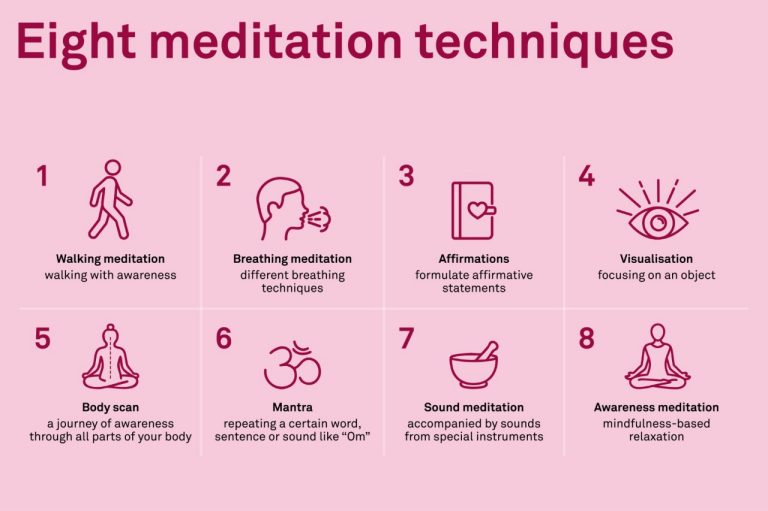
Over time, you’ll find out which technique suits you and your everyday life best. It’s crucial to choose a form of meditation that you can practice in the long term.
Relaxation courses – covered by Helsana
COMPLETA supplementary insurance covers 75% of the costs of recognised health promotion courses, up to a maximum of CHF 200 per year. Find out what benefits are included.
Meditation tips for beginners
Does your mind start racing as soon as you sit still? Do your legs or feet go to sleep? This is completely normal. Be patient with yourself and try out the following tips:
When your thoughts wander
Position a neutral object around a metre in front of you on the floor and observe it while you consciously pay attention to your breathing and count your breaths. Can only count to five? This is normal: your concentration will grow each time you try.
If you’re looking for an easier way to get started, try progressive muscle relaxation: With this method, you consciously tense individual muscle groups and then let go. Many people find it easier than exercises based around concentration or breathing alone.
Do your legs keep going to sleep?
Try meditating in a different seated position – one that’s comfortable even after ten minutes. You can also try sitting on a chair as you normally do. For some people, it is more comfortable to meditate while lying down. You may also get tingling in your legs if you’re wearing close-fitting clothes.
Accept your thoughts and feelings
Trying to stop all thinking won’t work. Let your mind be free. Accept any thoughts and emotions that come without criticising yourself for them. If you fight against it, the thought or emotion only gets stronger. Simply observe it, and then let it go.
Meditate at the same time and in the same place
If possible, meditate in the same place at the same time. This helps beginners establish meditation as a long-term habit more quickly: your mind and body will automatically associate the time and place with a relaxed, meditative state.
Be patient
Don’t expect results too quickly when you learn to meditate. It’s like a musical instrument: short daily practices are often more effective than one long session per week. And if you find yourself lacking motivation from time to time, it’s better to practice briefly than not at all.
A guide can help you learn how to meditate correctly. You can find simple meditation exercises in the free Helsana Coach app. A calm voice will accompany you through each exercise and guide you towards relaxation step by step. Since the guides are always available in the meditation app, you can easily integrate the exercises into your daily routine.
When’s the best time to meditate?
There is no generally right time of day for meditation: it’s more important to find a time that you can stick to consistently. Meditating at the same time, for example after breakfast or before bedtime, will make it easier to stick to the habit.
Morning meditation for at home
Morning meditation is particularly effective. Studies show that people who meditate in the morning tend to continue the habit. One reason for this is that the body’s cortisol levels are naturally higher in the morning. This hormone promotes alertness, focus and willingness to learn. In other words, this biological state also favours the formation of new habits. Plus, mornings are often less marked by distractions, which makes it easier to do something regularly.
At the same time, regular meditation changes the brain: the prefrontal cortex, responsible for rational thinking and self-control, becomes more active. The amygdala, a small area in the brain that processes emotional stimuli and plays an important role in the body’s anxiety, stress and alarm responses, becomes calmer.
Meditation to help you fall asleep: how to come to rest
Meditation also benefits those who suffer from racing thoughts in the evening or can’t switch off. The aim is not to stop the thoughts, but to let them go without getting lost in them.
Proven techniques for nighttime meditation:
- Body scan while lying down: this meditation is a guided body perception exercise. You let your thoughts wander over the body – from the soles of your feet to the crown of your head – and perceive what you feel without judging it. Focusing on physical sensations is particularly helpful when your thoughts are going round in circles.
- 4–7–8 breathing exercise: inhale for 4 seconds, hold for 7 seconds, exhale for 8 seconds. This breathing exercise activates the parasympathetic nervous system and calms the body. It’s a rather challenging exercise, especially if you haven’t yet established a meditation routine.
- Guided meditation: a guide will help you to stay on track and prevent your thoughts from wandering.
Ideally, you should meditate in bed or on a mat with the lights dimmed.
Establishing a habit is key
The decisive factor is not how long you meditate or which technique you choose: instead, it’s about regularly taking time for rest and mindfulness. If you’re under time pressure in the morning, you can use your lunch break to meditate briefly. Even 10 minutes of silence will help you clear your head and set you up for a stronger afternoon. In the evening, meditation helps you to let go of the day, calm your mind and fall asleep better.Try out different methods and find out which form of meditation best suits your daily routine.

Sandra Schwendener (occupational psychologist, certified stress management trainer, specialist in medical progressive muscle relaxation and mindfulness interoception® SGMEV in training) has worked at Helsana since 2016. As an expert in occupational health management, she develops strategies and measures to promote employees’ mental health. She offered advice and input for this article.

Newsletter
Find out more about current health issues every month and get all the information you need about our attractive offers from all Helsana Group companies * delivered by e-mail to read whenever it suits you. Our newsletter is free of charge and you can sign up here:
We did not receive your information. Please try again later.
* The Helsana Group comprises Helsana Insurance Company Ltd, Helsana Supplementary Insurances Ltd and Helsana Accidents Ltd.