
Stress management: strategies and tips to cope with stress
What is stress management? What does the stress hormone cortisol do to the body, and how can I reduce stress? What approaches and exercises can I try? Learn which strategies can help you manage stress and how to cope better with stressful situations.
Knowing and applying stress management strategies
Even with the best stress prevention methods, stressful periods are practically unavoidable. There will always be situations in which you find yourself under time pressure or feeling overwhelmed by certain events. In moments like these, dealing with stress in the right way is crucial. People who use a combination of strategies for coping with stress in everyday life are better equipped to boost their resilience and support their mental health over the long term.
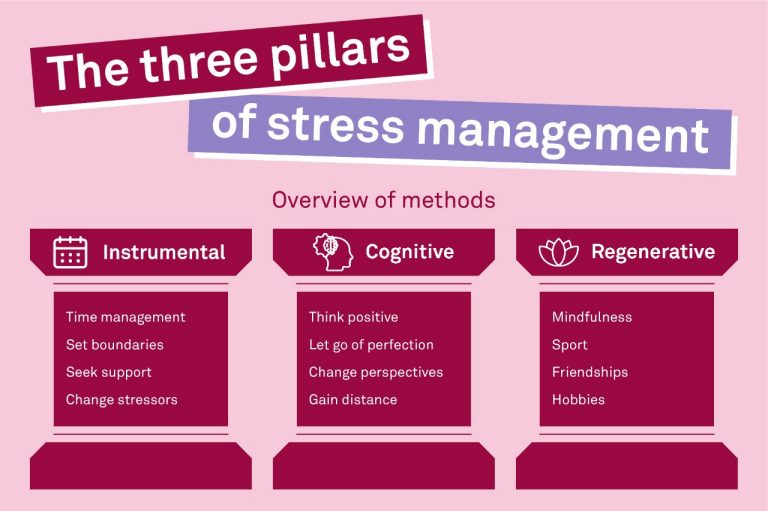
Experts differentiate between these strategies and categorise them according to the three pillars of stress management:
- Instrumental strategies
- Mental strategies
- Regenerative strategies
Stress is by definition more than just a feeling. When we’re stressed, our bodies start to release more stress hormones. Cortisol, often colloquially referred to as the stress hormone, plays an important role here. It provides us with energy in stressful situations and regulates the cardiovascular system, ensuring that the body remains able to respond.
This is useful in the short term. In the case of prolonged or chronic stress, however, the body’s stress system can remain permanently activated. This can increase cortisol levels and actually worsen typical symptoms of stress, such as tension, high blood pressure, a weakened immune system and an increased risk of mental illness.
The body needs sufficient time to recover after stressful periods to prevent stress from becoming a long-term issue. There are various stress management techniques we can use to help regulate the stress response in our bodies, recover more quickly and avoid chronic stress.
Instrumental stress management
Instrumental stress management is all about targeting stressors, or those factors that actually trigger stress. These could be anything from time pressure at work to difficult social situations. The idea of instrumental stress management is to use various measures to reduce or influence these stressors or to try to cope with them more effectively.
Reduce stress through effective time management
How can you reduce stress through effective time management? Here are some tips to help you:
- Focus on the most important tasks and set clear priorities.
- Create a to-do list and categorise your tasks according to how urgent and important they are.
- Complete the unpleasant or important tasks first; once they’re out of the way, the simple ones will be easier to deal with.
- Break down large tasks into smaller steps and complete them over several days.
- Always finish one task before moving on to the next wherever possible.
- Don’t take on too many tasks at once.
- Make sure you allow enough time for breaks and unforeseen events.
These tips will help you cope with stress at work and at home.
Set boundaries to reduce stress
Talk openly about your concerns and build up your ability to express yourself. Don’t be afraid to say “no” or “not now” if someone expects or asks something of you that you can’t do there and then. Many people struggle with this, whether it’s because they don’t want to disappoint anyone, they want to be helpful or they worry that their refusal won’t go down well.But if you keep setting your own needs aside, you’ll end up putting too much strain on yourself in the long run. Establishing boundaries isn’t selfish; it shows that you’re managing your time and energy responsibly. If you find that difficult, start with small steps. Practise in low-risk situations – for example, when you’re invited to a last-minute get-together but you’re just too tired. Say something like: “Not today, thanks” or “I need a bit of time for myself today”. It can also be helpful not to commit straight away. Give yourself some time to think and decide whether you really have the time and the energy for it. Phrases such as: “I’ll think about it and let you know” or “Sorry, I can’t commit to anything just yet” give you the time to make a conscious decision. By knowing your own limits and communicating them clearly, you can protect yourself from becoming overwhelmed. This will boost your health in the long term and help you remain productive.
Use social support to cope with stress
Seeking support, sharing burdens and accepting help are all effective strategies for coping with stress. Ask your family or friends to help you with things like cooking, shopping or organising your everyday tasks. Speak to people close to you about what’s weighing on your mind. Often, just talking about whatever’s bothering you can be enough to gain some perspective and see things in a new light. Many people find it difficult to accept support because they want to handle everything themselves or don’t want to be a bother to those around them. But accepting help is not a sign of weakness; it’s an effective way of coping with stress.
Make changes in your life
Sometimes managing stress more effectively isn’t enough. It’s not always possible to solve a situation by making small adjustments. That’s when a major change can help. If a situation is permanently causing you stress and shows no signs of improving, it’s worth thinking about alternatives.For example, moving house can be a good idea if your living situation is a constant source of stress. You should also think about your relationships or other factors in your life if they rob you of more energy than they give you. Decisions like these are rarely easy and they can take time. In the long run, however, they can help reduce stress and improve quality of life.
Mental stress management
Mental strategies for coping with stress start with your personal stress intensifiers. These include mental attitudes, patterns of thought and judgements that can contribute to stress. For example, if you view every little mistake as a failure, are an extreme perfectionist or have a tendency to ruminate and quickly jump to negative conclusions, you may experience more stress – even though, objectively, the situation is not threatening. It’s our subjective perceptions and judgements that make these situations stressful. The following strategies will help you recognise and change these kinds of thought patterns.
Use helpful thoughts to reduce stress
Reorganising your thoughts helps to combat stress. Try to view stressful situations as realistically as possible while remaining optimistic. For example, ask yourself whether your fears will actually be realised or whether there might be other possible outcomes.Remember, things rarely end up as badly as we fear at first. If you notice that you’re starting to ruminate, make a conscious effort to tell yourself “Stop!” and focus on what’s really important. Ask yourself: “What’s good about this situation?”, “What can I learn from this?” or “How likely is it that my fears will actually be realised?”
Trust in your own abilities and previous experience. It often helps to think about people who remain calm and optimistic in difficult situations as well. Use them as role models and ask yourself: “How would they handle this situation?”
Practise stress management by letting go of perfectionism
Forget about having to do everything perfectly. It’s better to approach things efficiently and with a sense of proportion. Aim for a good outcome rather than striving for perfection, as that often takes up a lot of time and energy and can cause unnecessary stress. Make a conscious effort to say to yourself: “I’m allowed to make mistakes”, “Sometimes less is more”, and “I’m going to do my best and take care of myself”. Thinking like this can help to put your own expectations into perspective and take some of the pressure off. Write down the sentence that speaks to you the most on a piece of paper and display it somewhere you’ll see it regularly.
Change your perspective to cope with stress
If you look at stressful situations from a different perspective, you can re-evaluate them and cope with them more calmly.
- Question your initial reaction. For example, in the event of a conflict, ask yourself whether your point of view is really the only one possible or whether you’re under particular pressure at that moment. When we’re stressed, we often look at situations in a more negative way. We can also be more prone to reacting emotionally and jumping to conclusions. What may appear perfectly manageable in a quieter moment can suddenly seem like a big problem when you’re under pressure. If you take a step back, you’ll find other courses of action, and you’ll be able to react more calmly as a result.
- Try not to be too quick to judge things, and look at situations with a positive attitude. For example, if a friend cancels on you, don’t take it personally. It’s most likely they have a perfectly valid reason.
- Make the effort to put yourself in someone else’s shoes. A change of perspective is a good way to broaden your horizons and encourage understanding and empathy for others. For example, ask yourself: “How would I assess the situation if I were in that person’s shoes?”
Reduce stress through distance
Accept that some things are simply beyond your control, and let go of everything over which you have no influence. You don’t have to have everything under control all the time. Instead, focus on what you can actually influence. Ask yourself: “What exactly can I do or influence in this situation?” Whatever goes wrong doesn’t say anything about your worth as a person.It’s also helpful to distance yourself from stressful thoughts. Take note of these thoughts by all means, but don’t get carried away by them. You can monitor them without reacting immediately. For example, when you have a stressful thought, write it down on a piece of paper and put it to one side. That way, the thought is still there, but it no longer takes up all your attention and it doesn’t determine your actions.
You can also try this useful mental image to help you: imagine you’re standing on a bridge over a motorway, watching the traffic pass underneath. The cars represent your thoughts; sometimes only one will pass by, sometimes there might be several at once. Some will really stand out, while others disappear quite quickly. The point is that you don’t have to follow any of these cars. No matter what happens, you stay where you are on that bridge and let the cars pass underneath. You can let stressful thoughts pass you by in the same way if you let go of them.
Regenerative stress management
External stressors and internal stress intensifiers can’t always be avoided or changed. That’s why regenerative methods for coping with stress are all about promoting physical and mental recovery and counteracting the effects of pressure. They include prioritising recovery phases, relaxation techniques and activities to promote good health.
Cope with stress through mindfulness and relaxation
Regular relaxation not only helps you relieve acute stress, but also helps you develop your ability to react more calmly in stressful situations over the long term. These stress management methods can help:
- Mindfulness: mindfulness means making a conscious effort to be aware of the here and now. You observe your thoughts, feelings and physical sensations without judging them straight away. This allows you to recognise stress at an early stage and respond to it more consciously.
- Meditation: meditation is all about finding peace and focusing the mind. It involves consciously directing your attention to something specific, like your breathing or sounds, which can help you put stressful thoughts out of your mind and relieve stress.
- Yoga: gentle exercises can help to ease tension caused by stress in the body. Conscious breathing is also a good way to calm yourself down. Yoga is particularly effective in offsetting a stressful daily routine.
- Breathing exercises: try breathing slowly and deeply into your abdomen, then pause briefly before exhaling slowly. This signals to your body that there is no immediate danger. It thus helps to reduce the stress response. Breathing exercises work quickly and can therefore also help to reduce acute stress.
- Mindfulness-based stress reduction (MBSR): this method for coping with stress has been well researched scientifically. It combines mindfulness, meditation and physical exercises, such as those often practised in yoga, in an eight-week programme.
Relaxation course – covered by Helsana
COMPLETA supplementary insurance covers 75% of the costs of recognised health promotion courses, up to a maximum of CHF 200 per year. Find out what benefits are included.
Use sport and exercise to reduce stress
Regular exercise and sport are also excellent ways to manage stress. Endurance sports such as cycling, swimming and jogging are particularly suitable, but other forms of exercise like strength training, yoga and hiking can also promote well-being. Regular physical activity helps regulate the stress system, relieve tension and boost mental health. But remember, very intense or excessive training can place added strain on the body.
Maintain friendships to reduce stress quickly
Social contact has an effect on how we deal with stress. It boosts our self-efficacy and self-worth, and both of these help us cope better with difficult situations. Studies have shown that social support is one of the most important protective factors against the negative consequences of stress. It can help us manage stress more effectively and boost well-being. Family and friends support each other, listen to one another and stand together in difficult times. This helps remind people that they are not alone. Without this support, stress often feels more difficult to deal with.
Maintain a healthy work-life balance
Stress often arises when commitments and unfinished tasks take up too much of our time, leaving us little room for relaxation. Be sure to make enough time for family, friends and hobbies as well. Leisure activities are a good way to put your worries to one side. Whether it’s painting, cooking, pottery, gardening or handicrafts, anything that makes you happy and helps you forget about everyday life for a while will give your mind some time to recover. It doesn’t matter how good you are at something; the important thing is that you enjoy doing it. Trying out new things and learning new skills can also boost self-confidence. So make a conscious effort to set aside time for activities that do you good.
What helps combat stress in everyday life over the long term?
By establishing set routines, you can counteract physical and mental symptoms during stressful periods. These tips can help you manage stress:
- There are various exercises you can try to cope with stress, from simply relaxing and letting your mind wander to special breathing techniques. Have a go at a few to find out what works best for you in stressful situations.
- Keep a stress diary. Note down the time and date, the situation and the trigger. Record how stressed you felt, how you reacted to it and what you did about it. This will help you identify patterns in your own behaviour, typical triggers and effective coping strategies. A stress test can also give you valuable information.
- Draw up an emergency plan with short-term stress management strategies that have helped you before. The plan could include playing a particular sport, breathing techniques, special exercises, relaxation methods or simply helpful thoughts. Then, in critical moments, you can take a look at your plan and you’ll know exactly what to do.
- Get into relaxing habits. Use “when–then” sentences. For example: “When I get up in the morning, I’ll do a short breathing exercise”, or “When I go to bed, I’ll think of three nice things that happened today”.
No one is immune to stress. But you can decide how you handle it. The stress management techniques outlined here give you a useful set of tools to work with. Try out different approaches to find out what works best for you in everyday life. However, if you notice persistent symptoms of stress or feel that you are severely affected on a day-to-day basis, you should speak to your doctor or another qualified specialist.
Stress management training with the Helsana Coach app
Do you often feel stressed in everyday life? The “Stress management” programme in the Helsana Coach app helps you recognise when you are stressed and practise useful stress management exercises (e.g. meditation).



The expert provided the editorial team with advice and input for this article. Pascale Ingold is an occupational psychologist (Master of Science (MSc) in Applied Psychology) and has completed a CAS in Practical Coaching. She works as a health & diversity specialist at Helsana. Pascale supports managers and employees with topics related to occupational health management.


Newsletter
Find out more about current health issues every month and get all the information you need about our attractive offers from all Helsana Group companies * delivered by e-mail to read whenever it suits you. Our newsletter is free of charge and you can sign up here:
We did not receive your information. Please try again later.
* The Helsana Group comprises Helsana Insurance Company Ltd, Helsana Supplementary Insurances Ltd and Helsana Accidents Ltd.