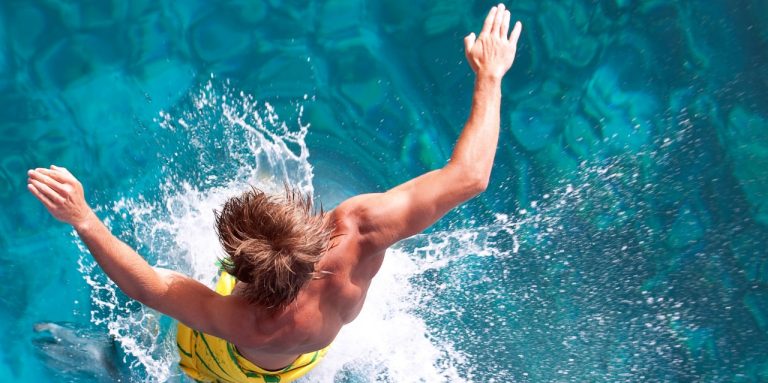
Safe swimming in outdoor pools and lakes
For many of us, a dip in the cool water is part of summer. But whether you’re in a lake or a pool, there are risks. Currents and overconfidence are dangerous. Knowing the most important swimming safety rules helps you stay safe and relax.
Overview of topics
What are the most important swimming safety rules?
Swimming safety rules help to prevent accidents in and around the water. By knowing and following these rules, you will be helping to ensure your own safety and the safety of others. The six rules of the Swiss Lifesaving Society (SLRG) are considered the standard for safe behaviour in the pool and for swimming in lakes or rivers.
- Always keep an eye on children in the water
Never let children go near the water unaccompanied. Young children must be supervised and within reach at all times. - No alcohol, no drugs and no swimming on an empty stomach
Never go into the water under the influence. Alcohol and drugs make you tired and impair your concentration, slowing your recognition of hazards and your response time.
Do not swim on an empty or very full stomach. Both can lead to circulatory problems. - Never jump into the water if your body is overheated
Your body needs time to adjust to avoid cold shock. Cool down before you go into the water. - Never leap into the unknown
Do not jump into murky or unfamiliar waters – there may be hazards you can’t see. - Never go into deep water with flotation devices
Air mattresses and flotation devices don’t provide adequate safety in deep water. - Never swim long distances alone
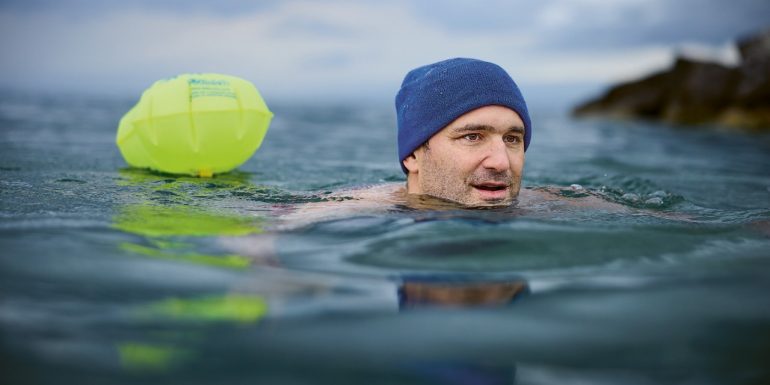
You should never swim long distances alone; even fit people can suffer sudden dizziness. Clearly visible floating buoys increase your visibility and safety.
Swimming not only helps you cool off in summer – it also has a positive effect on your health. Swimming is a holistic endurance and strength sport that combines several health benefits:
- Gentle on joints and back: buoyancy in the water means that only about 10% of your body weight impacts on your joints and spine. This makes swimming particularly suitable if you’re overweight or suffer from osteoarthritis or back pain.
- Cardiovascular training: regular swimming improves endurance, supports heart health and can lower blood pressure.
- Respiratory muscles and lung function: the rhythm of your breathing in the water strengthens the respiratory muscles and improves oxygen consumption.
- Use of numerous muscle groups for full body training: swimming involves almost all muscle groups at the same time, with varying degrees of intensity depending on the swimming style (e.g. front crawl, breaststroke or backstroke).
It’s worth noting that swimming is also an ideal introductory sport for people who are overweight. It’s gentle on the joints, as the buoyancy carries a large part of the body weight in the water. This significantly relieves pressure on the knees, hips and back.
It’s important that you start slowly, set realistic goals and pay attention to how your body feels. In the event of severe complaints or pre-existing conditions, seek medical advice beforehand.
Staying safe in indoor and outdoor pools
When temperatures rise, the swimming pool becomes the perfect spot for many of us: a dip in the cool water, splashing around with friends and perhaps the odd ice cream. Tanya Randegger from the Swiss Lifesaving Society (SLRG), a rescue organisation of the Swiss Red Cros, answers the most important questions about safety and conduct at the swimming pool.
Ms Randegger, any parents feel they can relax when their children are in the swimming pool. But are lifeguards really a substitute for parental supervision?
Lifeguards play an important role in ensuring safety in indoor and outdoor pools. Their presence also has a preventive effect, because they keep an eye on what’s going on and intervene before incidents occur. However, the responsibility for children remains with their parents or guardians at all times. Yet parents often lose sight of their children – for example, because they are engrossed in their mobile phones by the side of the pool. Drowning can happen very quickly and almost silently. But when the pool is crowded, it’s impossible for lifeguards to keep an eye on all swimmers at the same time. This means that parents or guardians are fully responsible for the supervision of their children at all times.
Is it true that strong swimmers are automatically safe in the water?
No, not at all. Even the best swimmers can drown.
A total of 15 water safety skills have been identified as necessary to prevent drowning. Being able to swim is just one of them. Even the best swimmers should always be alert in the water. People who feel too safe often take greater risks, putting themselves in danger.
From what age can children realistically assess risks in the water?
Awareness of hazards and risks develops gradually in children. It’s only when they’re about eight to twelve years old that they’re able to identify hazards and assess risks. However, a reliable, forward-looking ability to assess risks only develops in later childhood and adolescence.
At what age should children start swimming lessons?
Every child develops individually. Specifying or recommending an age across the board would not take this into account. It’s important that children become familiar with the water and learn how to move in it. A swimming course can help with this and promote safety, coordination and self-confidence. There are even swimming courses for babies. Rather than promoting swimming skills, they get babies used to the water. For physical and cognitive reasons, children don’t really learn to swim until they’re five or six years old. Being able to swim is not enough to be able to move safely in and on the water.
When is someone considered a good swimmer?
The water safety check provides a good indication of whether someone is ready to swim safely without supervision. It determines if they can keep themselves above water for one minute after falling in (simulated by doing a somersault into the water). This time allows them to get their bearings in the water. They then have to swim 50 metres. A safe swimmer can accurately assess the risks, use common sense in the water and move safely to the shore or edge at any time – even in unforeseen situations. However, this does not automatically mean that they can move safely in all types of water. Other risk factors come into play, particularly in open water. It is therefore difficult to provide a clear definition of a safe swimmer.
Tanya Randegger Tanya Randegger

Financial support for baby and child swimming lessons
Helsana supports exercise programmes for children. We cover certain costs in line with our commitment to health promotion. With COMPLETA PLUS, you will receive 75% of the invoice amount for swimming classes for babies and children, up to a maximum of CHF 100 per calendar year. This benefit applies to insured children until the end of the calendar year in which they turn five years old.
Please note that payment of costs only applies to recognised courses and providers.
Depending on the intensity, swimming is a highly effective fat burner. However, calorie consumption depends heavily on swimming style, intensity, body weight and technique. A front crawl burns more calories than breaststroke. Adults who weigh between 70 and 80 kilograms burn an average of 200 to 350 calories in 30 minutes of moderate exertion, and up to 500 in the same time at high intensity and speed.
Risks of swimming in open water
Conditions in natural bodies of water and indoor pools differ greatly. You need to take additional risks into account if you’re swimming in a lake or river. Nine out of ten drowning accidents occur in open water. So statistically speaking, swimming in a lake is more dangerous than swimming in a pool. Nevertheless, if you protect yourself by following a few basic rules there’s nothing standing in the way of a fun day in the water. These are the typical hazards of swimming in a river or lake:
Visibility: Visibility is often limited in open water. Murky water, waves and strong reflections can make it difficult to judge distances and spot hazards. Swimmers may not even notice boats or water sports equipment until it’s too late. Stay as close to the shore or riverbank as possible and ensure that you are easily visible, for example by wearing bright swimwear or a bright swimming cap and carrying a floating buoy.
Buoyancy: Buoyancy in the water can be deceiving. Cold water, tiredness or heavy clothing can make swimming feel strenuous more quickly than expected. Do not assume that your body will always stay afloat, especially if you’re swimming longer distances or in unfamiliar conditions.
Currents: Never swim against a current, as this requires a lot of strength. Let yourself drift with the current and try to swim at a slight angle towards the shore. Even if this initially causes you to drift further out, this is the safest way to get back to shore.
Exhaustion: Cold, currents and long stretches in the water can quickly lead to exhaustion. Remain calm and roll on to your back if you are very tired – this position will help you to save energy. If you experience cramps, try to carefully stretch the affected muscle while in the water and head for the shore or riverbank as soon as possible.
Weather: Even a single lightning bolt can be life-threatening. Water is an excellent conductor of electricity. Leave the water immediately in the event of a thunderstorm. Strong winds can also be dangerous, as they create waves that can carry swimmers away from the shore. The weather can often change surprisingly quickly at lakes.
Take swim breaks: Even in summer, the body cools down in the water, especially in children. It’s better to go into the water several times for short periods and take warm-up breaks on land in between. This keeps your circulation stable and reduces the risk of hypothermia.
Beware of the risk of injury: Before you jump into the water, check that it is deep enough. Rocks, branches and shallow areas are often difficult to spot in open water. Only jump into the water where you are sure it is deep enough.
Working together to improve water safety
Helsana has partnered with the SRC and the rescue organisation SLRG to raise awareness of safe behaviour on, in and around the water. Learn how accidents can be avoided – with preventative steps, swimming safety rules and courses to prepare you for an emergency.
What to do in the event of swimming accidents
Personal safety is better than rescue. Never jump blindly into the water to rescue a drowning person. They will try to hold onto anything, even their rescuer, and may pull you under water as well. Therefore, you should always help from a safe location.
Use aids such as a life ring, rope or floating items, perhaps an air mattress or surfboard. The person in distress can hold on to the item and be pulled to shore.
In the event of a swimming accident, the usual first aid rules apply. In an emergency, call the emergency services immediately. Only provide assistance if you can do so without putting yourself at risk.
In addition to drowning accidents, cuts are a common consequence of swimming.
These are caused by rocks or broken glass, among other things. If you’re injured, leave the water to prevent prolonged bleeding. Rinse the wound thoroughly. Apply pressure if the bleeding is severe. Cleanly cover the wound. In the event of deep cuts, heavy bleeding or dirty wounds, seek medical assistance.
A day at the lake or outdoor pool and swimming in the water are good for your body and mind. To keep you water fun safe, it’s worth following the swimming safety rules. If you’re swimming longer distances, a buoy provides extra safety, as does swimming with a partner. Children should always be closely supervised when they’re near the water.

The expert provided the editorial team with advice and input for this article. Julia Pieh (doctorate in pharmacy and toxicology, pharmacist, naturopath) works in the Helsana Health Consultation Service.
Newsletter
Find out more about current health issues every month and get all the information you need about our attractive offers from all Helsana Group companies * delivered by e-mail to read whenever it suits you. Our newsletter is free of charge and you can sign up here:
We did not receive your information. Please try again later.
* The Helsana Group comprises Helsana Insurance Company Ltd, Helsana Supplementary Insurances Ltd and Helsana Accidents Ltd.