Sugar substitutes – from erythritol to stevia
From honey in tea and stevia in coffee to xylitol in cakes, there’s no shortage of alternatives to sugar. But are they really better for you? Find out what makes sweeteners different from sugar alcohols and whether there is a healthy alternative.
What are sugar substitutes?
Sugar substitutes give foods such as desserts and soft drinks a sweet taste. If you’re looking for an alternative to sugar, there are two kinds: sugar alcohols and sweeteners. The main difference is that sugar alcohols still contain calories, whereas sweeteners contain virtually none.
Erythritol and xylitol belong to the chemical group of sugar alcohols. Because your body only partially absorbs them, most provide around 40% fewer calories than conventional sugar, supplying approximately 2.4 kilocalories per gram instead of 4 kilocalories per gram. Depending on the substance, they are not quite as sweet as sugar.
Sweeteners such as stevia, saccharin and sucralose are completely different substances in chemical terms – either artificially produced or of plant origin. They are practically calorie-free and many times sweeter than sugar. As for honey, date syrup and maple syrup, these contain about the same number of calories as table sugar.
Sugar alcohols
Common sugar alcohols include xylitol, erythritol and sorbitol. They are mainly found in chewing gum, sweets and sugar-free products. Sugar alcohols are a type of carbohydrate and are usually derived from plant-based raw materials. They taste similar to sugar, but they prompt less of a spike in blood sugar levels. What’s more, they don’t cause tooth decay. One drawback is that some of them can cause digestive problems when consumed in large quantities.
Birch sugar (xylitol) as a sugar substitute
The sugar alternative xylitol is also known as birch sugar. But what exactly is xylitol? It’s a sugar alcohol that bacteria causing tooth decay cannot break down, which is why it’s often found in chewing gum designed for dental care. Healthy people can generally tolerate up to 30 grams per day. This is a rule of thumb, not an official acceptable daily intake (ADI) – some people can tolerate more, others less. If a product contains more than 10% xylitol, the packaging will state: “May have a laxative effect if consumed in excess.”
If you have a higher risk of developing cardiovascular disease, you should only consume this particular sugar substitute in moderation. This is because xylitol may promote the formation of blood clots and thus increase the risk of a heart attack or stroke. You can recognise xylitol in food by the E number E967.
Erythritol as a sugar substitute
Erythritol is a sugar alcohol with about two-thirds of the sweetness of conventional sugar. Unlike other sugar alcohols, erythritol does not have any calories. It’s found in medicines as well as food; it masks the aftertaste of many active ingredients and serves as a carrier for tablets.
Erythritol is considered to be well tolerated, tooth-friendly and non-allergenic. However, it can cause diarrhoea when consumed in large quantities. Experts therefore recommend consuming no more than 0.5 grams per kilogram of body weight per day. For someone with a body weight of 70 kilograms, that would amount to 35 grams. This is equivalent to about 3–4 tablespoons, depending on whether the powder is granular or fine. Erythritol may have an adverse effect on the cardiovascular system, as it may cause blood platelets to clump under certain circumstances. However, the body also produces erythritol naturally. Researchers are therefore still unclear whether erythritol from food is responsible for this. Erythritol’s E number is E968.
Sugar alcohols such as xylitol or erythritol are suitable for diabetics because the body does not need insulin to metabolise them. The glycaemic index shows how much a food raises blood sugar levels; grape sugar (glucose) is used as a benchmark, with a value of 100. A food with a glycaemic index of 50 therefore raises blood sugar levels about half as much as glucose for the same amount of carbohydrates. Table sugar scores between 60 and 70, while xylitol has a value of 7 and erythritol’s is practically zero. People with type 2 diabetes therefore often opt for sugar substitutes such as xylitol or erythritol.
Sorbitol as a sugar substitute
Sorbitol occurs naturally in many fruits, such as apples, pears and peaches. In the food industry, it is used as a substitute for sugar in things like chewing gum, sweets and low-calorie products. Sorbitol is also used in medicines, for example as an additive in nutrient solutions. However, it is not suitable as a sugar substitute for people who are fructose intolerant: the body partially converts sorbitol into fructose, and it can also hinder the absorption of fructose in the intestines. You will find sorbitol numbered as E420.
Sweeteners
Sweeteners are versatile alternatives to sugar; they have a very intense sweetness, so only a small amount is needed. They contain few or no calories and – like sugar alcohols – do not damage the teeth. There are both artificially produced and natural sweeteners.
Stevia as a sugar substitute
Stevia is a natural sweetener derived from the leaves of the stevia plant, which is native to South America. The plant’s sweet-tasting compounds, known as steviol glycosides, are significantly sweeter than sugar and contain practically no calories. The food industry uses stevia to sweeten drinks, desserts and confectionery. In everyday life, many people use stevia as a sugar substitute in baking or in their coffee. It’s important to note that stevia belongs to the composite family. These plants are known to trigger allergies relatively frequently. Experts recommend consuming no more than 4 milligrams per kilogram of body weight of this natural sugar substitute per day. On food packaging, stevia is numbered E960.
Aspartame as a sugar substitute
Aspartame is a low-calorie sugar alternative and is about 200 times sweeter than table sugar, so you only need a tiny amount.
Experts have set an acceptable daily intake of 40 milligrams per kilogram of body weight for healthy adults. In 2023, the WHO’s International Agency for Research on Cancer classified aspartame as “possibly carcinogenic” on the basis of limited evidence. However, the Joint FAO/WHO Expert Committee on Food Additives saw no reason to change the ADI.
The body breaks down aspartame into its constituent components, including the amino acid phenylalanine. People with phenylketonuria, a congenital metabolic disorder, cannot break down phenylalanine and should therefore not consume aspartame. This is why products containing aspartame carry the legally required warning “contains a source of phenylalanine”. You can recognise aspartame by the E number E951.
Acesulfame K as a sugar substitute
Another alternative to sugar is acesulfame K. This artificially produced sweetener is around 200 times sweeter than sugar. Your body excretes it unchanged, so it doesn’t supply any calories. You’ll find acesulfame K in the list of ingredients as E950.
Saccharin as a sugar substitute
Saccharin is one of the oldest artificial sweeteners around. This sugar substitute is roughly 300 to 500 times sweeter than sugar and is calorie-free. In higher doses, it can leave a bitter aftertaste, which is why manufacturers tend to combine it with other sweeteners. Experts recommend an ADI of 9 milligrams per kilogram of body weight. Saccharin’s E number is E954.
Sucralose as a sugar substitute
Manufacturers obtain sucralose from ordinary sugar. It’s around 600 times sweeter than table sugar and contains no calories. Unlike saccharin, sucralose does not have a bitter aftertaste. Many people use this sweetener as a sugar substitute on a daily basis – in tablet form or as a powder to sprinkle over food. Sucralose’s E number is E955.
Take care when using sucralose in cooking and baking: once it reaches around 120°C, it becomes unhealthy when used as a sugar substitute, since carcinogenic compounds may start to form. Experts therefore advise against baking or cooking with sucralose. Only add it once the food has been cooked.
No, glycine is not a sugar alcohol or a sweetener. It’s actually an amino acid , or a protein building block, which has a highly sweet taste. The body produces glycine itself, so you don’t have to get it from your diet. Glycine is officially classed as a “flavour enhancer”. You’ll see it listed as E number E640.
Natural sugar substitutes with calories
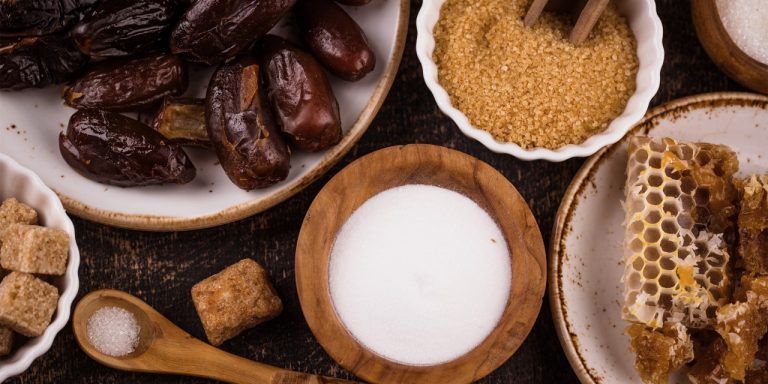
Many people looking for a healthy substitute for sugar choose a natural alternative. Some add honey to their tea rather than sugar, while others opt for maple syrup as a way to sweeten their muesli. Popular choices include:
- Honey
- Dates
- Coconut sugar
- Maple syrup
- Agave syrup
However, these substitutes are not actually considered healthy alternatives to sugar. This is because your body processes them in the same way as conventional sugar.
Are sugar substitutes better than sugar?
If you’re wondering which sugar substitutes are healthy, you’ll be disappointed to hear that experts generally consider sugar alternatives to be controversial at best – there is no such thing as genuinely healthy sugar. This also applies to natural products. Is agave syrup healthy just because it comes from a plant? Unfortunately not, since your body processes it in much the same way as table sugar. Honey and coconut sugar are not healthy alternatives to sugar either.
Artificial sweeteners are also not healthy substitutes for sugar, even though they often contain no calories. This is because if you consume them on a regular basis, you’ll get used to the intensely sweet taste. You may then find that other foods aren’t sweet enough. Sweeteners are therefore not suitable as sugar alternatives for children and adolescents.
The one exception here is if you’re trying to lose weight. In that case, sugar substitutes can be an option as part of a weight-loss diet – for example, if you swap drinks containing conventional sugar for low-calorie sweetened alternatives. However, you should always discuss this with your doctor beforehand.
Whether sugar alcohols and sweeteners are suitable for a no-sugar diet depends on your personal goals. If you want to cut out conventional sugar to avoid spikes in your blood sugar levels, sugar substitutes can sometimes be a good option. Natural sugar alternatives such as honey are not suitable in this case, however, because your body processes them in the same way as table sugar. If, on the other hand, you want to break the habit of craving sweet things, it’s best to avoid sugar substitutes as well.
Remember that, from a health perspective, there’s no need to cut out sugar completely. The WHO recommends that adults simply try to limit their consumption of sugar to 50 grams per day.
Whether it’s sugar or a sugar substitute, the amount is what really matters. Ultimately, neither is suitable as a basis for a balanced diet. That’s why it’s important to think carefully about what you eat and opt for vegetables, wholegrain products and sources of protein wherever possible. If you’re at all unsure, speak to your doctor or a nutritionist.

The expert provided the editorial team with advice and input for this article. Natalie Bez is a nutritionist (SVDE) and researcher at Bern University of Applied Sciences with a focus on obesity treatment, nutritional psychology and plant-based nutrition.


Newsletter
Find out more about current health issues every month and get all the information you need about our attractive offers from all Helsana Group companies * delivered by e-mail to read whenever it suits you. Our newsletter is free of charge and you can sign up here:
We did not receive your information. Please try again later.
* The Helsana Group comprises Helsana Insurance Company Ltd, Helsana Supplementary Insurances Ltd and Helsana Accidents Ltd.