Tattoo removal: procedure, costs and methods
Is laser tattoo removal painless? Do health insurance companies pay for tattoo removal? How many sessions do I need to have a tattoo removed? Find out more about laser tattoo removal and other treatments.
Overview of topics
Reasons for tattoo removal
There are many different reasons why people choose to have their tattoo removed. For some, the design no longer suits their current lifestyle – for example, due to a change of job or personal values. Others see their tattoo as a youthful mistake that they regret. Some people may not like the quality of the tattoo – say, if it is poorly done or blurry. The ageing process may also play a role: as we age, our skin becomes less elastic and the tattoo loses its shape. Many people with tattoos find this unattractive and opt for tattoo removal. Inflammatory or allergic reactions to a tattoo are another reason why some may wish to remove them.
There are different types of tattoos: amateur tattoos, professional tattoos, cosmetic tattoos and medical tattoos. For all types of tattoos, a tattooist uses a needle to inject insoluble organic or inorganic ink (pigment) into the middle layer of the skin (dermis).
Amateur tattoos generally use less pigment and are therefore often paler. They are usually easier to remove than professional tattoos. For professional tattoos, the tattooist uses a professional machine, in which a needle releases a lot of pigment into the dermis at high speed. There is a wide range of colours to choose from for professional tattoos. Cosmetic tattoos are often used to accentuate eyebrows or lips, while medical tattoos are used, for example, on patients undergoing radiotherapy and involve injecting the pigment more superficially. They are also easier to remove than professional tattoos.
Note that cosmetic tattoos often contain titanium dioxide or iron oxide. During laser tattoo removal, these substances can sometimes change their colour and appear darker or even yellowish.
Laser tattoo removal
How does laser tattoo removal work? Today, specialists use quality-switched (Q-switched) laser systems or picosecond lasers to remove tattoos. In Q-switched systems, the laser pulse is in the nanosecond range, while it is in the picosecond range for newer picosecond lasers. Different laser systems with different wavelengths are used depending on the colour of the tattoo. Black pigment, for example, reacts well to a wavelength of 694 nanometres (nm), which is equivalent to a ruby laser. For red pigment, by contrast, a wavelength of 532 nm works better. During treatment, the patient wears glasses to protect their eyes from the laser beams.
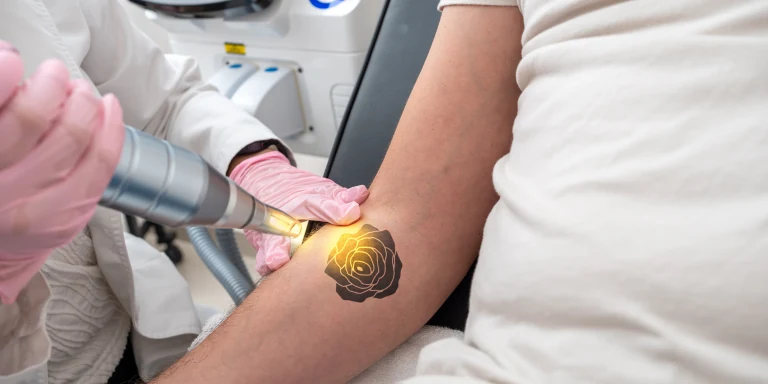
To remove a tattoo, the specialist moves the laser device along the tattoo. The pigment absorbs the laser energy and is broken up into lots of small parts. After this, the body’s own immune system springs into action, transporting the shattered pigment away – either via the lymphatic system or with the help of the body’s own phagocytes. This transport process takes a few weeks.
Bear in mind that this method of tattoo removal is unsuitable for a fresh tattoo, as recently tattooed skin takes around two months to heal. In other words, you cannot have laser tattoo removal before this point. In addition, the colour pigments in fresh tattoos are embedded deeper in the skin than in older tattoos, whose pigments reach the surface of the skin over time.
Laser tattoo removal: costs
The price of tattoo removal varies depending on the size, type and colour of the tattoo. Your practitioner will examine the tattoo and estimate how many sessions are needed for a satisfactory result.
Basic insurance does not cover the costs of laser tattoo removal in Switzerland. Is the tattoo you want to have removed on a clearly visible, aesthetically sensitive part of your body? Do you also have a medical prescription for the removal, including photo documentation? If so, we would be happy to check whether we can cover the costs of tattoo removal under our TOP, COMPLETA and COMPLETA PLUS supplementary insurance. As a health insurance company, we assume up to 75% of the costs for special forms of treatment under TOP and COMPLETA up to a maximum of CHF 3000 or CHF 4500 per calendar year. If you already have COMPLETA, you can extend your insurance cover with COMPLETA PLUS. With this supplementary insurance, you will receive reimbursement for the 25% excess under COMPLETA for special forms of treatment.
Bear in mind that your practitioner must submit an application for reimbursement of costs to us before starting your treatment.
Is laser tattoo removal painful?
Getting a tattoo can be painful. Laser tattoo removal can be too, which is why specialists usually use a numbing cream. This is applied around an hour before the treatment. If a tattoo is removed without numbing cream, the pain is similar to a rubber band snapping against the skin. Treatment for light black shades is generally less painful than for lighter pastel, white or green colours.
What does a tattoo look like after laser removal?
During the removal process, the tattoo changes: small gas bubbles form in the upper skin layer and the tattoo turns white. This colour usually disappears after a few minutes. After this, your skin may appear red, swollen and overheated – similar to sunburn. Minor skin bleeding may also occur from time to time. After laser treatment, the tattoo remains visible. One to three days after laser removal, some people develop small blisters on their skin, which form fine scabs over time. Over the next two months, the tattoo gradually fades. Bear in mind that faint shadowing (“ghosting”) from the tattoo can remain visible even after numerous sessions.
Laser tattoo removal: how many sessions?
How many sessions laser tattoo removal takes depends on the type of tattoo (amateur tattoo, professional tattoo, etc.). The location on the body is also a factor: tattoos on the face and neck are easier to remove than on the fingers or feet. This is due to better blood circulation and the numerous lymphatic vessels in the face and neck. The colour of the tattoo and the amount of pigment also have an influence. Black pigment and blue shades are easier to remove than reds or greens. Yellow tattoos are very difficult to remove. Skin colour also plays a role: dark skin requires a gentle approach so as not to damage the skin’s own pigment. This increases the number of treatments required. Even if a new tattoo is used to cover up an old one, a longer treatment period is to be expected.
Some people need between five and twelve treatments for a satisfactory result, while others require more than 20 sessions. With treatments using a picosecond laser, removal can sometimes take fewer sessions – for light black tattoos, for example, three to five sessions. A session usually lasts ten to 30 minutes. A gap of about six weeks to three months between treatments is recommended.
Be aware that, with laser tattoo removal, it’s important that the treated skin is well protected from the sun for the whole treatment period to avoid side effects. If necessary, take a break in summer if the tattoo is on a part of your body that’s difficult to cover. Autumn and winter months are the ideal time for laser treatment.
Remember that the results of tattoo removal are not always predictable: some tattoos cannot be removed completely. Therefore, talk to a medical professional who specialises in laser treatment if you want to have a tattoo removed. They will have the best idea of what is possible.

After laser treatment: what do you need to bear in mind?
If you have a tattoo lasered off, the aftercare is also crucial for the result. Bear the following in mind:
- Have you received a wound dressing? Wear it for several days – it supports the healing process. During treatment, your doctor will tell you how long you should ideally wear the dressing for.
- A cooling and disinfecting aftercare cream supports the healing process after tattoo removal.
- Make sure you keep the wound clean. Do not scratch or rub the wound.
- Wait a day after the laser treatment before taking a shower.
- How long should you wait to exercise after tattoo removal? Wait a few days before you start exercising again.
- After laser tattoo removal, avoid the sun for around a month and avoid sunbathing and tanning studios. Apply sun cream after this when you go out in the sun. Bear in mind that you should also consistently avoid the sun between your individual laser sessions.
Laser tattoo removal: what are the risks?
Laser-based tattoo removal has several side effects and risks:
- Scars: preventing scars is the primary objective of laser tattoo removal. If you visit an experienced professional, the risk of scarring is usually low. However, it is slightly increased for darker skin types or certain tattoo colours. The specialist treating you will discuss your personal risk with you.
- Pigmentation: after tattoo removal, your skin may suffer from hypopigmentation (lightening) or hyperpigmentation (darkening). This is because, in addition to the tattoo, the laser also destroys the melanin in the skin. This is why laser tattoo removal sometimes also lightens the surrounding skin – especially if the skin is dark. This pigmentation usually disappears on its own after a few months. In some cases, however, it can be permanent.
- Colour change: in some cases, the colour of the tattoo changes during laser removal: tattoos made of iron-based pigments are sometimes darker or have a red or yellow hue after laser treatment. Iron-based pigments are mainly found in cosmetic tattoos. Beige pigments change colour particularly often. Colour changes are persistent: some remain in place for the long term despite laser treatment.
- Burns and inflammation: laser therapies sometimes result in burns or inflammation – for example, if the energy used by the laser is set too high. You should therefore choose an experienced doctor to perform your tattoo removal.
- Potentially harmful degradation products: current research results show that laser tattoo removal may result in harmful degradation products. In animal studies and laboratory experiments, researchers found harmful compounds in some colour pigments. However, these experiments do not provide reliable information about degradation in the human body. Further studies with conclusive results are still pending.
Specialists advise against tattoo removal during pregnancy and breastfeeding. This is because it is unclear what consequences the degradation of pigments has for the mother. It is also unknown whether and how many breakdown products pass to your baby if you are pregnant or breastfeeding.
Tattoo removal without lasers
In addition to laser tattoo removal, there are other methods of tattoo removal. However, laser tattoo removal is considered the gold standard, as it has a low risk of unwanted side effects such as scarring.
Surgical tattoo removal
Removing tattoos using a surgical procedure makes sense, for example, if laser treatment is ineffective or the tattoo is very small. In surgical tattoo removal, the doctor removes the tattoo with a scalpel after a local anaesthetic and then stitches up the affected area. Skin transplants or skin grafts are occasionally necessary. This method is extremely effective, but often causes scars and is therefore rarely considered an option.
Tattoo removal using TEPR
“TEPR” stands for “trans epidermal pigment release”. In the TEPR procedure, the practitioner injects the skin with acids or enzymes that cause inflammation. The idea behind it is that the body reacts to the inflammation and expels the colour pigments with the wound secretions created. This method is less safe and effective than laser tattoo removal and the risk of scarring is very high. Other possible side effects include wound healing problems, pigmentation and faint shadowing (“ghosting”). In addition, more sessions with longer gaps between them are often required than with laser treatment. Experts advise against this procedure.
Tattoo removal using dermabrasion
In dermabrasion, a rotating abrasive head evenly removes the upper layers of skin and exposes the pigments for removal. A saline solution cools the skin during the treatment. Experts rarely use dermabrasion for tattoo removal because it carries an increased risk of scars, pigment disorders and infection. However, it is sometimes useful – for example, in the case of allergic reactions to tattoos.
Tattoo removal using chemical peels
Chemical peels are mainly based on fruit acid. This destroys the top layers of the skin, exposing the pigments beneath them. The practitioner then removes the pigments using an abrasion device or other chemical agents. Due to the high risk of scars and inflammation, specialists advise against this procedure.
Tattoo removal using a cover-up
A cover-up tattoo covers an existing tattoo, and is usually larger and darker than the original tattoo. Cover-ups are not actually a form of tattoo removal and therefore not an alternative for those who no longer want to have a tattoo. Also remember that just because your first tattoo did not trigger any allergies, an allergic reaction to the cover-up cannot be ruled out. Note that it sometimes makes sense to carry out laser treatment before a cover-up, when the tattoo is very dark, for example.
There are creams that supposedly allow you to perform tattoo removals yourself. These are often bleaching creams that are ineffective and damage the skin. Do not use this method under any circumstances. Instead, seek advice from a medical professional.
Bear in mind that, aside from these creams, there are other methods that supposedly allow you to remove your tattoo yourself, especially a fresh tattoo. These include salt scrubs and home remedies such as lemon juice or aloe vera. None of these methods are suitable for tattoo removal.
Whether laser tattoo removal or cover-up – there are different methods of tattoo removal that meet different needs. Therefore, first seek advice from a dermatological practice – ideally one specialising in laser treatments – if you want to get rid of an old tattoo. Under no circumstances should you use do-it-yourself creams. At best, these will have no effect; at worst, they will cause severe burns and scarring.

Dr Natalie Anasiewicz is a senior physician in the dermatology clinic at University Hospital Zurich. She provided the editorial team with advice and input for this article.
Newsletter
Find out more about current health issues every month and get all the information you need about our attractive offers from all Helsana Group companies * delivered by e-mail to read whenever it suits you. Our newsletter is free of charge and you can sign up here:
We did not receive your information. Please try again later.
* The Helsana Group comprises Helsana Insurance Company Ltd, Helsana Supplementary Insurances Ltd and Helsana Accidents Ltd.