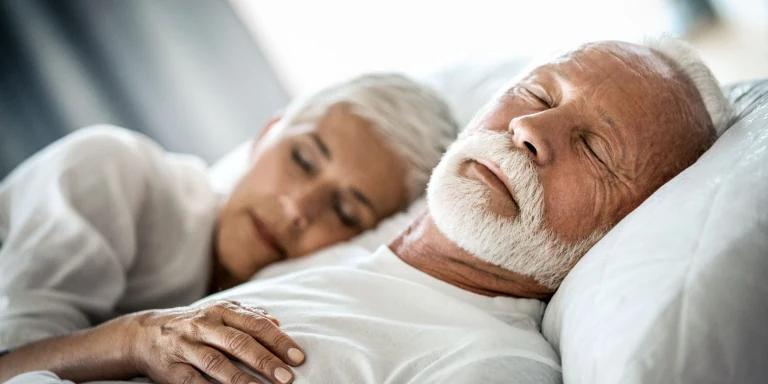
Overview of sleep stages and sleep cycles
What does a normal sleep cycle look like? Do we really only dream during REM sleep? And how long should deep sleep last? What happens in the light sleep stage? We explain the four stages of sleep in simple terms – and give you practical tips for improving your sleep.
Topics at a glance
What happens when you sleep?
During our sleep, we only appear to be inactive. In fact, once we fall asleep, complex neurophysiological processes take place in precisely defined stages. Sleep is essential for the body and mind. While you’re sleeping, your organs and tissues regenerate, your immune system is strengthened and your brain processes everything you’ve experienced during the day. The body goes through different main sleep stages, each of which serves a different purpose. These stages can be divided into two basic types:
- Non-REM sleep (non-rapid eye movement): non-REM sleep includes the “falling asleep” stage, the light sleep stage and the deep sleep stage. During these three stages, the body gradually shuts down its activity. Your heart rate, blood pressure and breathing slow down, and your muscles become increasingly relaxed.
- REM sleep (rapid eye movement): the abbreviation “REM” reflects the rapid eye movements that occur behind closed eyelids during this stage. REM sleep is when the most intense dreams take place and the brain processes emotional experiences.
Sleep stages usually follow a recurring pattern. The following sections explain each stage in detail.
“Falling asleep” stage
The “falling asleep” stage marks the transition from being awake to being asleep. Your consciousness alternates between waking and sleeping and your muscles begin to relax. The duration of this sleep stage varies considerably from person to person. Minor twitches when falling asleep are normal; these are a sign of increasing muscle relaxation. People often sweat when falling asleep, as the body actively lowers its core temperature. During this stage, your sleep is still very light. Even quiet sounds, such as the vibration of your mobile phone, can wake you up.
Light sleep stage
During the light sleep stage, brain activity slows down and the body continues to relax. The stage makes up the largest proportion of the total sleep time, at around 50%, and lasts around 30 to 60 minutes per cycle. Even during this stage, the brain starts to process experiences from the day. However, the sleep is still light: external stimuli such as noise or light can easily cause you to wake up. Snoring also often sets in during this main sleep stage, as the muscles in the throat relax more and more.
Deep sleep stage
The deep sleep stage is the most restful part of sleep, when the body releases more growth hormones, cells renew themselves and the immune system is strengthened. During this stage, sleep is particularly deep – even loud noises rarely wake you up. Adults normally spend about 1 to 2 hours per night in deep sleep. The deep sleep stage is longest in the first sleep cycle and becomes shorter with each subsequent cycle. Occasionally, phenomena such as sleepwalking or sleep-talking occur during deep sleep.
REM sleep stage
REM sleep is particularly important for mental recovery. During this stage, the brain organises what has been learnt and consolidates it in the long-term memory. The most vivid dreams also take place at this time. Brain activity levels are similar to those during wakefulness – hence the term “paradoxical sleep”. Despite this high level of brain activity, the skeletal musculature slackens almost completely, with this natural paralysis preventing sleepers from acting out their dreams. The normal duration of REM sleep is around 1.5 to 2 hours per night. In contrast to deep sleep, REM sleep stages lengthen with each cycle: the last REM stage is therefore significantly longer than the first.
How long does a sleep cycle last?
In a sleep cycle, you go through all four sleep stages once. A sleep cycle lasts about 90 to 110 minutes and is repeated four to five times per night. Sleep is divided into stages of varying sleep depth. Short periods of wakefulness occur between the individual cycles; these usually only last a few seconds and are completely normal. The composition of the cycles changes over the course of the night. In the first half of the night, deep sleep predominates; in the second half of the night, REM sleep takes up the bulk of the time.
How much sleep is healthy?
The amount of sleep you need varies depending on your lifestyle, state of health and ((Link: https://www.helsana.ch/de/blog/koerper/koerperwissen/schlaftypen.html))sleep type. Some people feel fully refreshed after just 6 hours, while others require up to 10 hours. Adults need an average of 7 to 9 hours of sleep per night. The duration is not the only thing that matters. The quality of sleep, in particular, determines how well-rested you feel the next morning. Several aspects are characteristic of a healthy sleep cycle:
- Falling asleep quickly: it usually takes no longer than 30 minutes to fall asleep.
- Short periods of wakefulness: long periods of night-time awakeness are the exception.
- Every stage covered: you experience all the stages of sleep every night.
- Deep, restful sleep: you get enough deep sleep and REM sleep.
Not getting enough sleep long-term can affect the entire body. The consequences of having too little deep sleep and sleep deprivation include persistent tiredness, poor concentration, a weakened immune system and weight gain.
Babies’ sleep is fundamentally different from adult sleep. Newborn babies sleep for around 14 to 17 hours a day, divided into several short bursts of 2 to 4 hours. Their sleep cycle lasts only about 60 minutes and consists of two stages: active sleep (REM) and inactive sleep (non-REM). During REM sleep, babies often make movements such as twitching, grimacing or breathing irregularly. In deep sleep, by contrast, babies lie still. Parents can tell that their baby is in deep sleep because the child’s breathing is even and they hardly move, even when touched.
Unlike adults, babies start their sleep cycle in REM sleep and spend around half of their sleep in this active dream phase. Between the third and sixth months of age, the sleep stages get longer and longer, with babies often sleeping for more extended periods of time.
How much deep sleep and REM sleep should you have?
The quality of your sleep depends on whether you get enough deep sleep and REM sleep: both fulfil different functions and are essential for physical and mental recovery.
Adults spend around half of the night in the light sleep stage. If this lasts too long and the deeper stages are rarely reached, your recovery suffers. The following figures for deep sleep and REM sleep serve as a guide:
- Deep sleep: around 15 to 25% of the total sleep time per night.
- REM sleep: around 20 to 25% of the total sleep time per night.
Insufficient deep sleep or REM sleep usually results in symptoms such as persistent tiredness, poor concentration, a weakened immune system, cravings and emotional irritability. Those affected don’t feel rested – even if they spend enough time asleep. The most common reasons for not getting any (or enough) deep sleep and REM sleep include chronic stress, alcohol consumption and irregular sleeping times. Alcohol mainly suppresses REM sleep in the second half of the night, while stress makes the transition to deep sleep more difficult.
The proportion of deep sleep decreases as you get older. In many cases, the proportion of deep sleep drops to less than 10% of the total sleep time from the age of 60 onwards. Getting just 30 minutes of deep sleep a night is not uncommon at this age. The duration of the individual sleep stages shifts in favour of light sleep, which makes up an increasingly larger proportion of the night. REM sleep remains stable up to the age of 60 and also decreases slightly thereafter, while the number of nocturnal waking phases increases. Waking up frequently is a normal part of the ageing process and not a cause for concern. What matters is how well-rested you feel in the morning.
In some cases, REM sleep behavioural disorder (RBD) occurs from the age of 60. Those affected act out their dreams on a physical level – they talk, hit or kick in their sleep – as the natural muscle paralysis that occurs during REM sleep doesn’t work completely. This affects around 5% of people over the age of 60, predominantly men.
Improving deep sleep and REM sleep
You can actively influence the quality of your own sleep. Even simple adjustments to your daily routine can help you sleep better and wake up well-rested in the morning. Take changes in your sleeping patterns seriously and pay attention to your sleeping habits.
If sleep issues last for several weeks and don’t improve despite good sleep hygiene, seek medical advice. An examination in a specialised sleep laboratory will help determine any issues and show whether your sleep stages are as they should be.
Between the sleep stages, there are moments when waking up is particularly easy. Sleep stage alarm clocks make use of this principle to wake you up during a light sleep stage within a specified time window. Sensors in the wristband record your movements and detect when you are in a light sleep stage. This enables you to wake up more gently and comfortably after a complete sleep cycle.
Sleep trackers also record additional sleep data. Using motion sensors and heart rate measurement, they track your sleep stages, sleep duration and general sleeping behaviour. This data provides useful information about your sleep quality. Please note: while sleep trackers provide guidance, they are no substitute for a professional examination in a sleep laboratory.
Tips for a better sleep routine
Tried-and-tested sleep tips can help you to improve your sleep quality in the long term. The following recommendations will help you boost your deep sleep and get more REM sleep:
- Find your sleep rhythm: go to bed at the same time every evening and get up at the same time in the morning. A regular rhythm stabilises the transitions between the main sleep stages throughout the night.
- Stay physically active: exercise has a positive effect on sleep stages and encourages deep sleep in particular. Build regular exercise into your daily routine, but don’t plan intensive sessions immediately before going to bed.
- Reduce alcohol and caffeine: avoid caffeinated drinks from late in the afternoon onwards and don’t drink alcohol in the evening.
- A balanced diet: opt for light meals in the evening and avoid fatty foods. Consume your last meal at least 2 to 3 hours before going to bed.
- Optimise your sleep environment: a cool, dark and quiet bedroom is ideal. The recommended room temperature is around 16 to 18 degrees Celsius.
- Reduce screen time: the light from smartphones, tablets and laptops influences the release of the sleep hormone melatonin. Put electronic devices away at least an hour before going to bed.
- Herbal supplements: natural sleep remedies such as valerian or lavender are considered to promote sleep. However, there is no conclusive scientific proof of their efficacy. Talk to your doctor before taking these substances.
Good sleep starts in the day. Pay attention to your habits and give your body the peace and quiet it needs for a restful night.
Every night, your body goes through a finely tuned series of different sleep stages. The better you understand this, the easier it will be for you to promote deep sleep and improve your sleep quality in the long term. Listen to your body’s signals and make sure you get the sleep you need. After all, a good night’s sleep isn’t a luxury – it lays the foundation for a healthy and active life.

The specialist provided the editorial team with advice and input for this article. Monika Fäh Rüegg is a nurse specialising in psychiatry and a systemic mental trainer, and has completed training in Viktor Frankl’s meaning-centred counselling. She works in Case Management at Helsana.

Newsletter
Find out more about current health issues every month and get all the information you need about our attractive offers from all Helsana Group companies * delivered by e-mail to read whenever it suits you. Our newsletter is free of charge and you can sign up here:
We did not receive your information. Please try again later.
* The Helsana Group comprises Helsana Insurance Company Ltd, Helsana Supplementary Insurances Ltd and Helsana Accidents Ltd.