
Consequences of a lack of exercise: facts and prevention
Sitting for hours and hardly moving around in your daily life can lead to a lack of exercise. This can have a serious impact on your health. Find out here why exercise is so important and how you can actively combat a lack of exercise.
Overview of topics
What does a lack of exercise mean?
A lack of exercise occurs when you do not move enough in your day-to-day life and spend a lot of time sitting down. This is bad for the body and in the long term can even reduce life expectancy.
To benefit from the positive effects of an active lifestyle in the long term, the Federal Office of Public Health (FOPH) and the Federal Office of Sport (FOSPO) recommend regular endurance-oriented physical activity at medium intensity, as well as strength training on at least two days a week. You should take frequent breaks from prolonged sedentary activities.
Causes of lack of exercise
Sitting for long periods during the workday or school day, as well as spending a lot of time in front of a screen during leisure time, contributes to inactivity. Being short of time, stressed or demotivated also leads to a lack of exercise in everyday life.
Gym membership – covered by Helsana
COMPLETA supplementary insurance covers 75% of the costs of recognised health promotion courses, up to a maximum of CHF 200 per year. Find out what benefits are included.
Health consequences of a lack of exercise
Muscles break down when they’re not used regularly. Other symptoms of a lack of exercise include fatigue, listlessness, muscle weakness, back pain and tension. Mental performance and resistance to stress also decline. If a lack of exercise persists over a long period of time, the health consequences become more severe. These include:
- Cardiovascular disease: a lack of exercise weakens the cardiovascular system. Sitting for long periods impairs blood circulation and vascular function and, over the long term, increases the risk of cardiovascular disease and cardiovascular mortality. People who do not get enough exercise are at a higher risk of thrombosis.
- Metabolism and diabetes: long periods of sitting and a lack of exercise slow down the metabolism and reduce energy consumption. Regular exercise significantly reduces the risk of type 2 diabetes. If type 1 diabetes is diagnosed, physical activity improves the effect of insulin and helps to lower the long-term blood sugar count (HbA1c).
- Weight gain: too little physical activity influences your metabolism and body composition and promotes excess weight gain.
- Risk of falling: a lack of exercise increases the risk of falls.
- Increased sensitivity to pain: a lack of exercise increases your sensitivity to pain.
- Cancer: inactive adults are more likely to develop breast, bowel or prostate cancer. Physical activity reduces both the incidence and mortality of these diseases by positively influencing your hormone balance, metabolism and inflammatory processes, among other things.
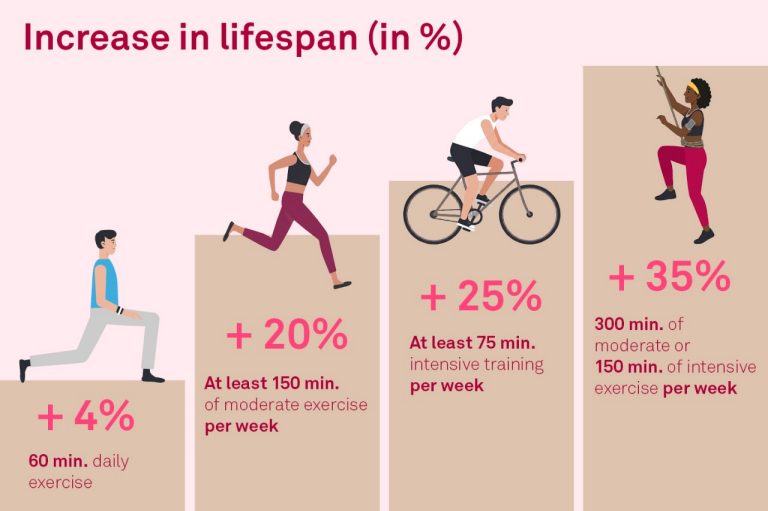
- Overall mortality: getting enough exercise has been proven to extend life expectancy and make us age more healthily.
Exercise supports mental health
Exercise not only has a physical impact, but also a mental one. Taking short breaks to exercise reduces stress and improves your mood and concentration. Exercise has been proven to boost your happiness. Studies confirm that physical activity releases happiness hormones, which put us in a good mood.
Regular exercise also has a positive effect on our sleep and quality of life, as well as on our mental performance, for example in terms of concentration, focus and flexible thinking. A lack of exercise, on the other hand, can contribute to a depressive mood.
Lack of exercise in children
A lack of exercise often starts when we are young. A lack of exercise in childhood can impair the child’s physical and mental development and increase the risk of the child becoming overweight.
Exercise has a fundamentally positive effect on health. You are most likely to see health benefits when the intensity is sufficiently high. Medium intensity is when your breathing speeds up, your pulse increases and the effort is noticeable, but you’re still able to talk. At high intensity, you start to sweat a lot and can only exchange a few words.
How much exercise is optimal
The recommended amount of exercise depends on your age and state of health.
Exercise recommendations for babies
Babies should have the opportunity to move freely several times a day, in an age-appropriate environment, as this promotes their natural urge to move.
Exercise recommendations for preschool-aged children/toddlers
Toddlers and pre-school aged children need to be physically active for at least three hours a day. The intensity of the activities does not matter.
Exercise recommendations for children and adolescents
Younger children generally enjoy moving and you shouldn’t set them any limits. Children and adolescents should do at least one hour of exercise a day, with several moderate and higher intensity sessions a week. Ideally, young people should follow a varied exercise programme with playful elements to train their strength and endurance while increasing their flexibility and dexterity.
Exercise recommendations for adults
For adults, the aim is to improve stamina and strengthen the muscles. They should do at least 150 to 300 minutes of moderate-intensity exercise every week, such as brisk walks, cycling, dancing or gardening. If you have less time to spare, you can do 75 minutes a week at a higher intensity. You can also spread the exercise intervals over several days a week. Complement these exercise sessions with strength training on two or more days. This could be strength training exercises, vigorous work in the garden or consciously climbing stairs to train your leg strength.
Exercise recommendations for pregnant women
If the pregnancy has been problem-free, two and a half hours of exercise per week at a medium intensity is generally recommended. Women who were active before their pregnancy can do their usual exercise routines for as long they feel able to do so. If you are uncertain or have any pre-existing conditions, you should consult your gynaecologist.
Exercise recommendations for older people
Exercise keeps older people mobile for longer, and enables them to have an independent life.
This does not mean you have to strive to keep up with top athletes, though. You can achieve the greatest positive health effect with at least 150 to 300 minutes of medium-intensity endurance exercise (e.g. cycling, gardening and housework, etc.) or at least 75 to 150 minutes of high-intensity exercise (e.g. swimming, cross-country skiing and cardiovascular training) per week. In addition, it’s a good idea to include strength and balance exercises that involve all main muscle groups on two or more days.
Exercise recommendations for people with pre-existing conditions
For people with pre-existing conditions or physical limitations, it’s advisable to seek individual advice from a specialist before introducing a new exercise routine.
Combating a lack of exercise
There’s a lot you can do to incorporate more exercise into your daily routine. Even simple activities such as climbing stairs, short walks or deliberately choosing longer routes can have a positive effect. Short bursts of exercise measurably improve health, especially in people who were previously largely inactive. Do you already exercise regularly? If you do, targeted training in line with the WHO minimum recommendations is particularly beneficial to your health. Sitting for long periods is an independent risk factor.
Habits: why they matter
Exercise becomes a habit when it’s done regularly in similar everyday situations.
It’s not the duration that matters, but the repetition. This works particularly well when exercise fits seamlessly into your daily routine. Positive experiences support this process: if you enjoy doing something, you’re more likely to keep doing it for the long term. Social interaction also has a motivating effect. Training with others or playing sports as part of a team strengthens bonds, creating a meaningful synergy between social connections and exercise.
Children derive particular benefit from experiencing exercise early on. What they learn in childhood is easier for them to carry over into adulthood.
Unbalanced diet and too little exercise
Nutrition influences how energetic we feel in our day-to-day lives. Heavily processed and high-energy foods can make you feel sluggish, which often reduces your desire to exercise.
A lot of sugar can also lead to energy fluctuations. This makes physical activity less appealing. If this diet is combined with little exercise, it can easily lead to a calorie surplus.
Get rewards by exercising
Connect your fitness tracker to the Helsana+ app and earn valuable points through the exercise you do. You can convert the points you collect into cash, vouchers from selected partners or make a donation. Helsana+ is compatible with Apple Health (iOS), Google Fit (Android), Fitbit, Garmin, Polar, Withings and Suunto.


How to make your exercise routine a success
Once you’ve incorporated your first exercise routines into your daily life, it’s a good idea to continue building up your fitness.
Look for endurance and strength sports that are fun and meet your needs. This will make it easier to keep at it.
- Fitness: strength training, group fitness
- Team sports: football, basketball, floorball, ice hockey, handball, volleyball, rugby
- Relaxation: yoga, t’ai chi, Pilates
- Fun and action: mountain biking, bouldering, slacklining, skateboarding, skiing, snowboarding, tobogganing
- Water sports: swimming, rowing, surfing, snorkelling, sailing, diving
- In the great outdoors: walking, Nordic walking, jogging, hiking, climbing, mountaineering, horse riding, cycling, bootcamps, winter sports, orienteering
- Music: dancing, Zumba, aqua fitness, gymnastics
- With friends: badminton, tennis, squash, table tennis, in-line skating, tandem, golf, Frisbee
- Competitive sports: martial arts, fencing, Swiss wrestling
- Other ideas: gymnastics, Hornussen (traditional Swiss sport), ice-skating, curling
Regular exercise protects your health
A lack of exercise is widespread across all age groups. Regular exercise can significantly reduce the risk of many chronic illnesses. What matters is not peak performance, but sufficient intensity and consistency. Consciously integrating exercise into your daily routine not only sustainably improves your physical health, but also your mental health.

The specialist provided the editorial team with advice and input for this article. Astrid Gabriel is a physiotherapist, psychological advisor and coach. She works for the Helsana health consultation and assists customers with questions relating to counselling.
Newsletter
Find out more about current health issues every month and get all the information you need about our attractive offers from all Helsana Group companies * delivered by e-mail to read whenever it suits you. Our newsletter is free of charge and you can sign up here:
We did not receive your information. Please try again later.
* The Helsana Group comprises Helsana Insurance Company Ltd, Helsana Supplementary Insurances Ltd and Helsana Accidents Ltd.