Chronotypes: your sleeper type and what it says about you
Are you an owl or a lark? Find out how your body clock works, why some people are particularly energetic in the evening and what role chronotypes play in this. Then take our online test to find out what type of sleeper you are.
What are chronotypes?
Chronotypes, also known as types of sleepers, describe a person’s individual sleep pattern. The term comes from Greek and roughly translates as “type of time”. Chronotypes indicate the time of day at which a person prefers to fall asleep and wake up and when they are particularly productive.
While some people spring out of bed full of energy first thing in the morning, others don’t hit peak form until the evening. These differences aren’t about how long we sleep, but about when we sleep. At the same time, the chronotypes also influence concentration and metabolism. Our body clock sets the rhythm behind these processes.
How does the body clock work?
Your body clock is your inner time-keeping system. It synchronises numerous bodily functions with the cycle of day and night, thus controlling the sleep stages. In technical terms, this process is known as the circadian rhythm (from Latin circa “about” and dies “day”). A complete cycle of the circadian clock takes around 24 hours.
The body clock is located in the hypothalamus, a central control area of the brain. From there, it sends signals to the body via nerve pathways and hormones, thereby setting the rhythm. To ensure the biological schedule aligns with the time of day, the body clock needs regular cues from the environment. The most important of these is daylight. Meal times, exercise and social habits also influence the circadian rhythm and the body clock, but they don’t alter the underlying chronotype.
Exactly how this rhythm works varies from person to person. This results in the different types of sleepers.
Enjoy a good night’s sleep with the Helsana Coach app
Relax your body and calm your breathing – using the tips and exercises for a better night’s sleep, you can combat sleeping problems in the short and long term.
Download the Helsana Coach app now and let’s get started.


What types of sleepers are there?
In science, there are various models that describe types of sleepers. They categorise people into different groups based on their natural sleep–wake pattern. Two classifications in particular have become established. Both models can help you to understand your body clock and to categorise your personal rhythm.
The classic model: the lark versus the owl
The distinction between larks and owls is one of the oldest when it comes to classifying types of sleepers. As early as the beginning of the 20th century, researchers observed systematic differences in the sleep patterns and productivity levels of different people. This led to the distinction between morning people (larks) and evening people (owls). To this day, this model forms the basis of chronotype research and shapes many scientific studies on the circadian rhythm of sleep.
The two types differ in terms of when someone wakes up, falls asleep and is most productive:
Larks
- Larks: early birds with a body clock that runs slightly faster than the actual time of day. Larks find it easy to get out of bed in the morning and experience their most productive period before midday. In the evening, however, they tend to tire quickly. The lark chronotype therefore refers to people who go to bed early and wake up early the next day.
- Owls: slow to get going in the morning, they need time to fully wake up mentally. They are at their most productive in the afternoons and evenings, and they rarely go to bed before midnight. In the case of owl chronotypes, the body clock runs slightly behind the actual time of day.
Larks and owls represent the two extremes of this model. In reality, very few people fall at one end of the spectrum or the other. The vast majority belong to what’s referred to as the mixed or standard type. People in this group combine characteristics of both chronotypes: they don’t go to bed particularly early or especially late and adapt well to the usual daily routine.
The four types of sleepers according to Michael Breus: lions, wolves, bears and dolphins
American sleep specialist and clinical psychologist Michael Breus has expanded the conventional lark–owl model. He describes four types of sleepers and assigns each one to an animal whose behaviour reflects the respective rhythm. In addition to sleep–wake patterns, the model also takes account of personality traits and typical periods of productivity throughout the day.
The following overview presents the four types of sleepers:
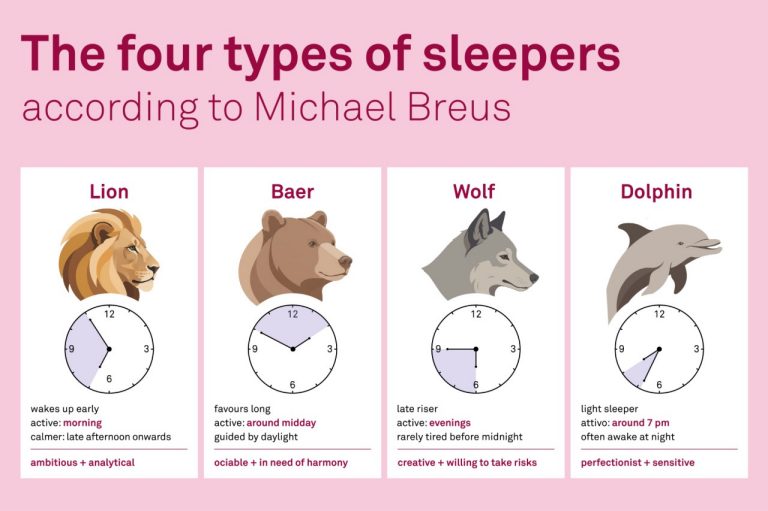
- Lions: wake up early in the morning and are already alert and productive in the first few hours of the day. Right after getting up, they plan their day and tackle challenging tasks before noon. In the late afternoon, their energy levels dip and they fall asleep quickly in the evening. People with the lion sleeper type are considered ambitious, conscientious and analytical.
- Bears: sleep a lot and deeply, but still often feel exhausted in the mornings and like to hit the snooze button. They are most productive around midday. People with the bear sleeper type are strongly influenced by natural daylight and align their rhythm with the cycle of day and night. Bears are considered sociable, cheerful individuals who value harmony. They steer clear of conflict.
- Wolves: struggle to get going in the morning and prefer to get up after 11 am. Their energy levels only really kick in later in the evening; wolf chronotypes rarely go to bed before midnight. They often feel out of place in standard working environments where things start early. Wolves are considered creative and are happy taking risks, although they can be seen as moody or impulsive.
- Dolphins: light sleepers, they wake up several times during the night and often feel tired in the morning. They experience a burst of energy around 7 pm and go to bed shortly before midnight. Breus associates the dolphin chronotype with high intelligence, perfectionism and a tendency towards sensitivity or inner restlessness.
Mixed forms are also common in the four-type model. Many people recognise traits of several types in themselves and cannot be clearly assigned to one specific type.
It’s important to note that Michael Breus’s types of sleepers are presented in a popular science style and are based on his clinical experience and patient profiles. There is no broad scientific validation of his model, as there is for the lark–owl model. Nevertheless, the model provides a clear guide for everyday life. It helps us to better understand our own sleep patterns and when we are at our most productive.
Chronobiology: what does the science say?
Chronobiology is a separate branch of the life sciences. It investigates temporal processes in living organisms and their adaptation to the environment. One area of focus is on human sleep–wake patterns. Current research into the chronobiology of sleep shows that chronotypes are not subjective perceptions, but are based on measurable biological foundations.
Around 20 genes are now known to control the rhythm of the body clock. These genes regulate how fast or slow an individual’s sleep–wake cycle is. This means that the types of sleepers are well documented scientifically and are largely determined by genetic predisposition.
In addition to genetic predisposition, other factors influence our sleep pattern:
- Daylight and lighting: the brightness in the morning and evening determines when the body releases melatonin.
- Sleep and eating habits: a regular sleep schedule and fixed mealtimes help maintain a stable rhythm. Irregular habits can disrupt your body clock.
- Work demands: shift work or fixed working hours can disrupt natural sleep and wake cycles.
- Age and time of year: the body’s rhythm adapts to external changes such as shorter days in winter.
The distribution of chronotypes in the population has also been investigated in large-scale studies of sleeper types. Pronounced early risers and evening types are in the minority. The majority of people fall somewhere in between in terms of their rhythm and combine characteristics of both extremes.
Chronotypes are genetically determined and cannot be changed at will. Nevertheless, external factors can have an influence. These include daylight, regular sleep times and fixed routines.
What’s more, our sleep–wake pattern changes naturally over the course of our lives. Children are often early risers. During puberty, many people develop a later rhythm, meaning they stay up later in the evening and find it harder to get out of bed in the morning. From mid-adulthood onwards, the body clock moves forward again. As a result, many older people go back to being early risers.
What’s my chronotype?
There are several ways to determine your own chronotype. Two main methods are used in research.
One common approach involves detailed scientific questionnaires that record sleep behaviour on working days and days off and use this data to determine your chronotype. Medical tests carried out in a laboratory provide even more accurate results, for example by measuring levels of the sleep hormone melatonin in saliva or using newer methods such as the analysis of hair roots. These methods deliver precise results, but they are complex and can only be carried out under controlled conditions.
But you don’t need a laboratory test to get a basic idea of your chronotype. Even a simple test can help you find out what type of sleeper you are. However, these are no substitute for a medical assessment. They merely provide an indication as to whether you tend to be an early riser, an evening person or more of a mix. If you are experiencing persistent ((Link: https://www.helsana.ch/en/blog/body/knowledge-of-the-body/sleeping-disorders.html)) sleep problems or feel constantly out of sync with your own rhythm, you should talk to your doctor.
Take the test: are you a lark, an owl or a bit of both?
The following chronotype test will help you find out whether you’re more of a lark, an owl or a mixture of the two. There are three statements to choose from for each section. Choose the one that best describes you, and make a note of the corresponding number of points. At the end, add up all your points and check the results to see which type of sleeper best describes you.
|
|
|
|
|
|
|
|
|
|
|
|
|
|
|
|
|
|
|
|
|
|
|
|
|
|
|
Falling asleep
- I go to bed around 10 pm and usually fall asleep quickly. (1 point)
- I never go to bed at the same time. (2 points)
- I usually go to bed between 10 pm and 1 am. (3 points)
Sleeping through the night
- I almost always sleep right through. (1 point)
- I wake up several times as morning approaches. (2 points)
- I find it difficult to fall asleep, but afterwards I sleep through. (3 points)
Waking up in the morning
- I’m usually already awake before the alarm goes off in the morning and get up immediately. (1 point)
- My wake-up routine is different every day. (2 points)
- I often hit the snooze button in the mornings – I find it difficult to get up. (3 points)
Waking up once you’re out of bed
- As soon as I get up, I’m immediately fit and alert. (1 point)
- How quickly I really wake up varies a lot. (2 points)
- I need time in the morning to become wide awake. (3 points)
Productivity over the course of the day
- I’m most productive in the morning or early morning. (1 point)
- My productivity varies depending on how I’m feeling that day. (2 points)
- I’m most productive in the afternoon and in the evening. (3 points)
Planning your day
- I prefer to tackle important tasks in the morning. (1 point)
- I usually plan my day spontaneously. (2 points)
- I prefer to schedule important conversations for the evening. (3 points)
Relaxing during the day
- I can only really relax and switch off in the evening. (1 point)
- I virtually never relax. (2 points)
- Night-time is the best time for me to relax. (3 points)
Getting up on days off
- I wake up early even on my days off. (1 point)
- When I have a day off, I sometimes wake up early and sometimes wake up late. (2 points)
- I love sleeping in on my days off. (3 points)
Evaluation
- 8 to 12 points: you’re a lark.
- 13 to 18 points: you’re more of a mixed type.
- 19 to 24 points: you’re an owl.
What chronotypes can tell us about energy and health
A daily routine that suits the type of sleeper you are results in greater productivity, increased alertness and better concentration.
In everyday life, however, our individual rhythms seldom fit in with the fixed schedules of school, work and family life. For late chronotypes in particular, having to start work early in the morning can quickly become stressful. This phenomenon is known as social jet lag and describes the discrepancy between a person’s biological clock and social time constraints. Early risers generally find it easier to cope with a typical working day.
People who are constantly out of sync with their body clock often experience more than sleep deprivation. Studies have linked social jet lag to an increased risk of being overweight and suffering from cardiovascular disease. Our mental health can also become unbalanced in the long run. Aligning your chronotype with your work can create a stable basis for improved well-being.
Fine-tuning your body clock: practical tips
Even small changes to your daily routine can help keep your body clock running smoothly. Using the following tips, you can make the most of your chronotype’s potential while also improving your sleep. These recommendations apply regardless of what type of sleeper you are:
- Stabilise your sleep pattern: go to bed and get up at the same time whenever possible, even on your days off.
- Soak up the morning light: head outside and get some daylight as soon as you get up, as this synchronises your circadian rhythm. Just 15 to 30 minutes in the morning can have a positive effect.
- Reduce blue light in the evening: the blue light from smartphones, tablets and TVs inhibits the sleep hormone melatonin. Reducing screen time in the hour before you go to bed makes it easier to fall asleep.
- Plan your meals: a balanced diet with regular mealtimes supports your chronotype and stabilises your metabolism. Ideally, your last big meal of the day should be a few hours before bedtime.
- Limit your caffeine and alcohol intake: both disrupt your sleep. Avoid caffeine in the late afternoon and evening, and only drink alcohol in small quantities.
- Get some exercise: regular physical activity promotes restful sleep and a stable rhythm. Exercise is particularly beneficial for your specific sleeper type if you do it during your peak productivity and performance phase – in the morning for early risers, and in the afternoon or evening for night owls.
Listen to your body’s signals, as they can tell you a great deal about your personal rhythm. Spells of tiredness and low levels of concentration are not a sign of weakness; they’re valuable clues about your body clock. There are many other sleep tips which can complement the measures suggested above and help you get a more restful night’s sleep.
People are all different, and so too are their daily routines. Taking a close look at what type of sleeper you are shows when your body has more energy and when it needs rest. Armed with this knowledge, you’ll be able to determine the best working hours for your chronotype. You can also organise your rest periods, social activities and personal routines in alignment with your body clock.

The specialist provided the editorial team with advice and input for this article. Monika Fäh Rüegg is a nurse specialising in psychiatry and a systemic mental trainer, and has completed training in Viktor Frankl’s meaning-centred counselling. She works in Case Management at Helsana.

Newsletter
Find out more about current health issues every month and get all the information you need about our attractive offers from all Helsana Group companies * delivered by e-mail to read whenever it suits you. Our newsletter is free of charge and you can sign up here:
We did not receive your information. Please try again later.
* The Helsana Group comprises Helsana Insurance Company Ltd, Helsana Supplementary Insurances Ltd and Helsana Accidents Ltd.